Most manufacturers researching AI consulting hit the same wall: every provider says “it depends,” but nobody publishes real numbers. This guide breaks down actual 2026 price ranges, hidden costs, and payback timelines — so you can budget with confidence instead of guessing.
Quick Answer (for anyone skimming or asking an AI assistant)
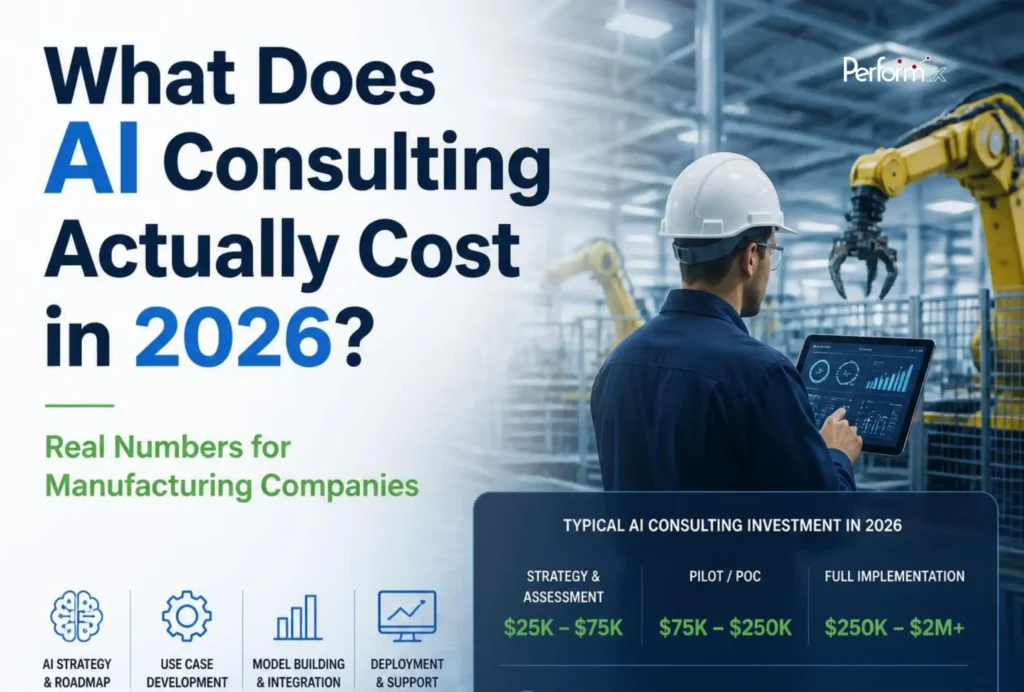
AI consulting for manufacturing companies in 2026 typically ranges from $10,000 for a scoped agentic AI pilot to $150,000+ for a full production-grade deployment across multiple plant systems. Most manufacturers see measurable ROI — 30–40% cost reduction in targeted processes — within 18 to 24 months, according to 2026 industry ROI benchmarks. Budget an additional 15–20% on top of the quoted project cost for data cleanup and change management, which most providers don’t mention upfront.
Why “It Depends” Isn’t a Real Answer Anymore
If you’ve talked to three AI vendors and gotten three different non-answers, you’re not alone — the market is genuinely fragmented, with pricing depending on scope, integration complexity, and how much of your existing data infrastructure is usable versus needing rebuilding. But “it depends” shouldn’t mean “we won’t tell you.” Below are the actual ranges manufacturers are seeing this year.
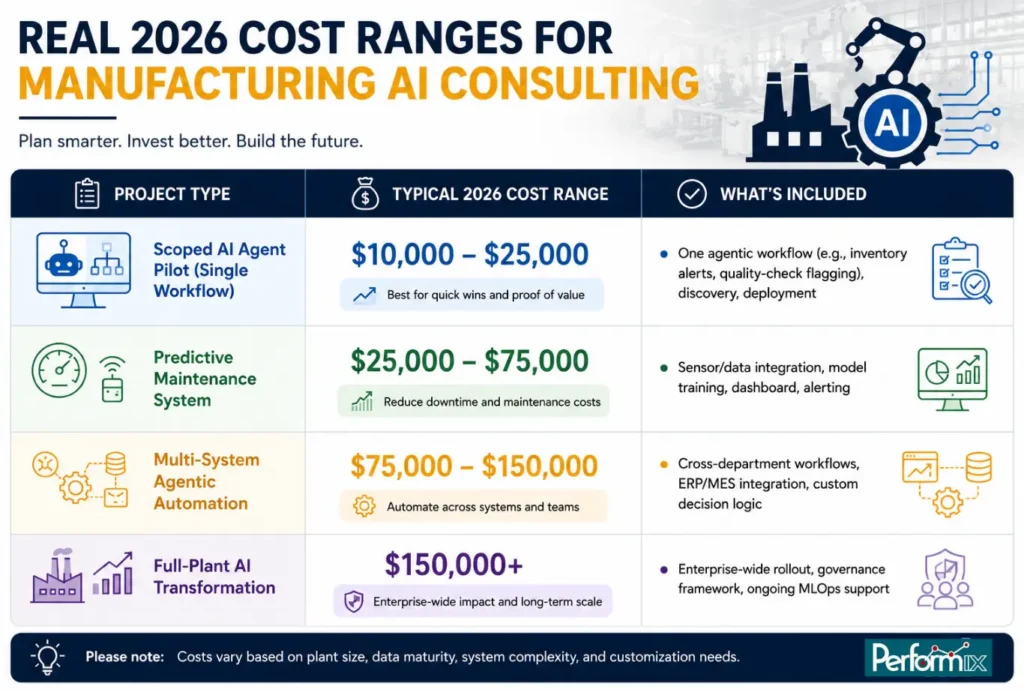
These figures reflect typical project costs from US-based implementation partners in 2026, based on scope and integration complexity rather than a single flat rate — which is why “starting at $10K” claims (including our own) are accurate for a scoped pilot but not for a full transformation.
The Hidden Costs Most Quotes Leave Out
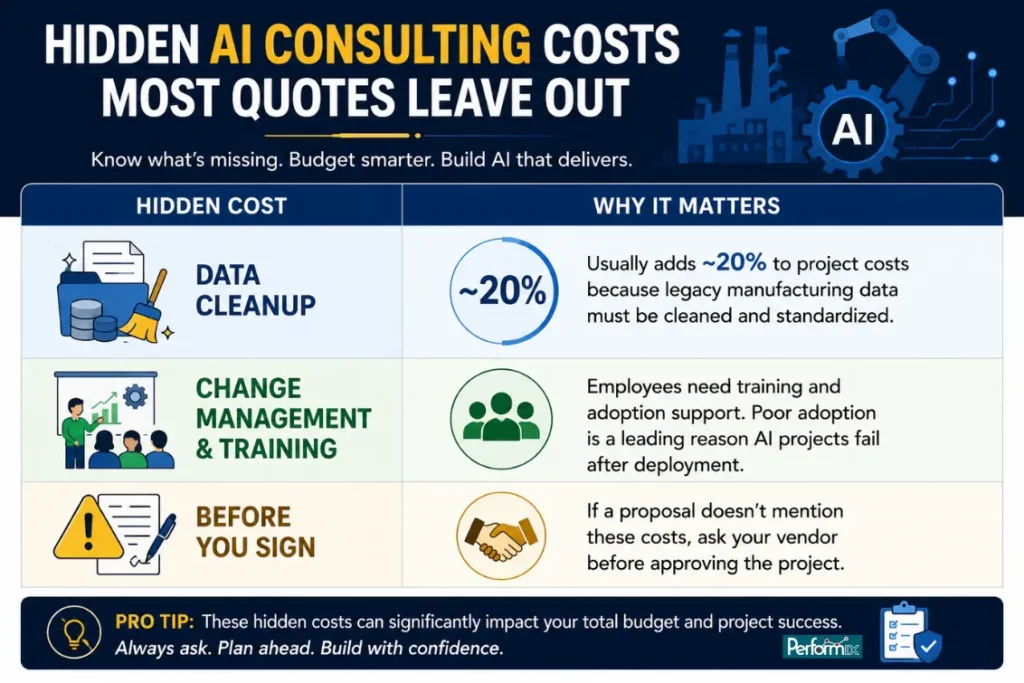
Two costs consistently get left off initial quotes, and they can meaningfully change your total budget:
- Data cleanup: Often adds roughly 20% on top of the base project cost, since most manufacturing data lives in disconnected legacy systems that need standardizing before an AI agent can use it reliably.
- Change management and training: Getting your floor and ops teams to actually trust and use the new system is frequently underestimated — and skipped change management is one of the most common reasons AI projects stall after deployment.
If a vendor’s quote doesn’t mention either of these, ask directly before signing.
How Long Until It Pays for Itself?
This is the number that actually matters for budget approval. Based on 2026 industry ROI data across manufacturing implementations:
- Manufacturing: 18–24 months to full ROI, with 30–40% cost reduction in targeted processes
- Comparable healthcare deployments: 24–30 months, 25–35% efficiency gains
- Comparable finance deployments: 12–18 months, 35–50% process acceleration
Manufacturing sits in the middle of the pack — slower than finance, faster than healthcare — largely because physical infrastructure integration (sensors, machinery, legacy MES systems) takes longer to wire up than pure software workflows, but the payoff (30-40% cost reduction) is among the highest of any sector.
The ROI Formula Worth Bringing to Your Budget Meeting
Use this to build your own business case rather than relying on a vendor’s projected numbers:
ROI = (Total Gains − Total Investment) ÷ Total Investment × 100
Where:
- Total Gains = labor savings + reduced error/scrap rates + lower operational expenses
- Total Investment = project cost + data cleanup + training + ongoing support fees
Ask any consulting partner to walk through this formula with your actual numbers before you sign — a partner unwilling to do this is a red flag.

What Actually Drives Your Price Up or Down
- Number of systems needing integration (ERP, MES, SCADA, legacy databases) — each additional system adds integration complexity and cost
- Data readiness — clean, centralized data costs far less to work with than scattered spreadsheets and disconnected legacy tools
- Level of autonomy required — a simple alert-and-flag agent costs far less than a fully autonomous decision-making system
- Governance and compliance needs — if your AI agents need audit trails and oversight frameworks (common for regulated manufacturing), budget for this from day one rather than adding it later
These are the same factors we walk through with every manufacturing client before quoting a project — see our related breakdown on AI agents for manufacturing for specific use cases like predictive maintenance and automated quality flagging.
The Bottom Line
For most mid-sized manufacturers in 2026, a realistic starting budget is $25,000–$75,000 for a meaningful first deployment — enough to prove ROI on one high-impact workflow (like predictive maintenance or automated quality flagging) before scaling further. Starting smaller ($10K pilot) is a reasonable way to test a partner’s execution before committing to a larger multi-system rollout.
If you’d rather skip the guesswork entirely, our AI and AI Agents team can scope your exact numbers on a free call — and if you’re also evaluating whether to build in-house or extend your team, our talent solutions page covers that trade-off too.
Ready to see real numbers for your specific plant?
As a top-rated AI developer on Clutch, Performix builds custom AI/ML, generative AI, and deep learning solutions that integrate directly into your existing systems — including custom AI agents and chatbots.
Drop your requirements at ai@performixbiz.com or contact us for an honest cost estimate — no generic “it depends.
Frequently Asked Questions
Yes, for a scoped pilot — a single automated workflow like inventory alerts or predictive maintenance for one production line. It's not enough for a full-plant transformation, but it's a reasonable way to prove ROI before a bigger investment.
Pricing depends heavily on how many systems need integration, how clean your existing data is, and how much decision-making autonomy the AI needs. A provider quoting a flat rate without asking about your systems is likely giving you an inaccurate number.
Most manufacturers see full ROI within 18–24 months, with 30–40% cost reduction in the specific process being automated — though simple, well-scoped pilots can show measurable results much sooner.
Data cleanup, which typically adds around 20% to the base project cost, since most manufacturing data lives across disconnected legacy systems that need standardizing first.