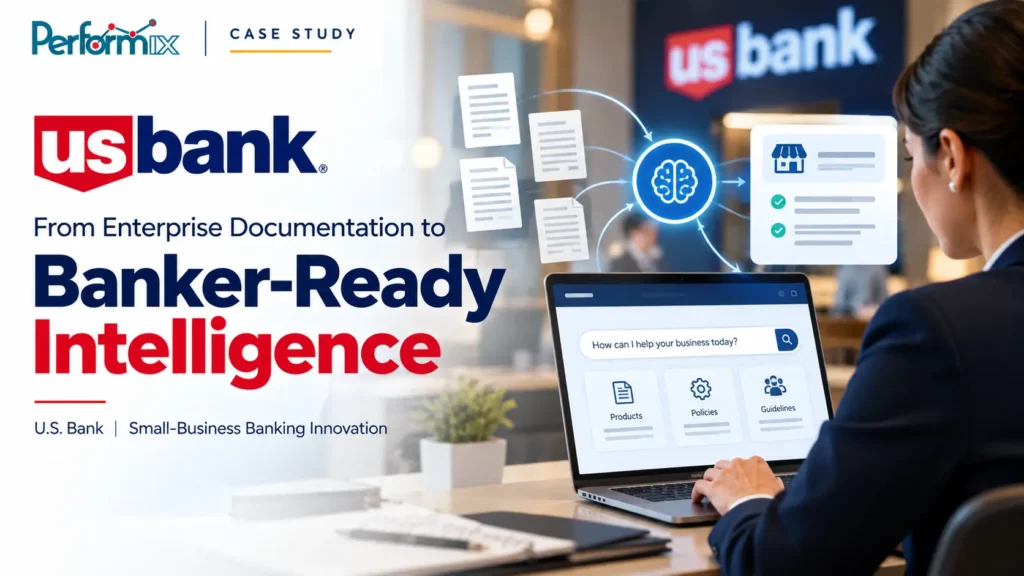
From Enterprise Documentation to Banker-Ready Intelligence
How Performix turned the documentation small-business bankers already relied on into a searchable, context-aware knowledge platform, easing the training burden created by high banker and teller attrition.
THE BUSINESS IDEA Don’t make employees memorize the organization. Make the organization’s knowledge work for the employee. |
Executive Snapshot
Client | U.S. Bank |
Industry | Small-Business Banking |
Business Challenge | High banker and teller attrition created a recurring training and knowledge-transfer burden. |
Business Need | Make existing small-business banking knowledge easier to find and use during customer preparation. |
Performix Role | Designed and built a searchable knowledge platform with the bank’s innovation team. |
Knowledge Source | Documentation used by small-business bankers in day-to-day work and customer preparation. |
Processing Period | Approximately 3–4 months to process and train the available information. |
Banker Experience | Google-like search with results tied to the customer’s business context. |
Example | A plumber seeking financing: relevant products surfaced and summarized. |
Business Outcome | Faster preparation, lower knowledge burden and minimal interface training. |
Why this case matters: High attrition is usually treated as a hiring and training problem. U.S. Bank treated it as a knowledge-access problem and made its existing knowledge available at the moment a banker needed it, rather than expecting every new banker to memorize it.
1. The Business Challenge
U.S. Bank’s small-business banking operation had high banker and teller attrition. Experienced employees could leave after a relatively short time, while the bank kept investing time and money in training their replacements.
Turnover also created a knowledge-transfer gap. Each new banker had to learn products, documentation and business processes before they could support customers with confidence.
THE KEY QUESTION How can an organization reduce the knowledge burden on new bankers without expecting every employee to memorize a large body of information? |
2. From Training Burden to Knowledge Access
U.S. Bank’s innovation team was looking for ways to reduce the cost of knowledge transfer while making bankers more effective. Performix worked closely with IBM Watson during this period as part of the bank’s AI initiative.
Performix reframed the opportunity around a simple principle: the bank already had valuable knowledge. The task was to make that knowledge easier for employees to find, understand and apply.
THE SHIFT From “How do we train every banker to know everything?” to “How do we help every banker find the right knowledge when it is needed?” |
3. From Documentation to Searchable Knowledge
Performix asked U.S. Bank for the documentation small-business bankers used in their day-to-day work and when preparing for meetings with prospective customers.
That information was processed and prepared for use in the platform, a phase that took approximately three to four months.
The result was a platform built around a familiar, Google-like search experience rather than a complicated specialist interface.
4. The Banker Experience
The experience was deliberately simple. Instead of navigating large volumes of documentation, bankers searched the way they already searched the web, starting from the customer rather than from the document.
Document-first | Where is the information I need? |
Question-first | What information do I need for this customer? |
5. Contextual Intelligence in Action
Consider a plumber seeking financing. Rather than searching several documents to work out which products might apply, the banker could ask the platform, which surfaced the relevant products and summarized them.
The banker received a concise one- or two-page summary to prepare for the prospect conversation. The value lay in connecting enterprise knowledge to the customer’s business context, not in retrieving a document.
THE PATTERN Business context → relevant knowledge → concise summary → better-prepared banker |
6. From Knowledge Retrieval to Banker Readiness
The platform was not meant to turn bankers into technology specialists. It reduced how much they had to memorize before they could use the bank’s information effectively.
Traditional | Train → Memorize → Search documents → Prepare → Meet customer |
Knowledge-enabled | Search → Retrieve → Understand → Prepare → Meet customer |
7. Business Value
The platform did more than speed up document retrieval. It made the bank’s knowledge accessible to the employees who needed it:
- Faster preparation: bankers found relevant information without manually working through large volumes of documentation.
- Lower knowledge burden: employees did not need to memorize every product detail before starting productive customer conversations.
- More accessible institutional knowledge: documented knowledge became available through one common interface.
- Easier onboarding: new employees could find what they needed without relying entirely on lengthy training or experienced colleagues.
- Better customer preparation: bankers prepared around the customer’s business situation instead of searching for generic product information.
8. A Scalable Foundation for Enterprise Knowledge
The lasting pattern is enterprise knowledge transformation: collect internal documentation, process it, make it searchable, add business context and return concise information at the point of need.
Enterprise Documentation | Capture the organization’s existing knowledge. |
Knowledge Processing | Prepare information for retrieval and use. |
Search Experience | Give employees a familiar way to access knowledge. |
Contextual Retrieval | Connect the search to the business situation. |
Summarization | Turn relevant information into concise output. |
Employee Action | Put useful information in the banker’s hands at the point of need. |
Knowledge → Context → Intelligence → Action
The original implementation belongs to its project era. The same pattern can be built today with modern cloud, AI, enterprise search and analytics technologies.
9. Adoption & AI Significance
Bankers needed minimal training after implementation. They mainly had to learn the interface, because the underlying knowledge was already accessible through the platform.
The engagement was Performix’s first AI project inside U.S. Bank and an early AI solution for a major U.S. bank.
THE IMPORTANT LESSON AI mattered here because it made enterprise knowledge usable at the moment a business decision had to be made. |
10. What This Demonstrates About Performix
- Problem-led delivery: the project was shaped around employee attrition, training burden and knowledge accessibility, not AI for its own sake.
- Enterprise knowledge transformation: existing documentation became a more accessible employee resource.
- Contextual intelligence: general knowledge was connected to specific customer situations.
- Human-centered technology: the experience was designed around how bankers actually work.
- Cross-functional execution: the engagement connected business stakeholders, the innovation team, technology, data and end users.
- Repeatable capability: the same pattern applies to any enterprise whose knowledge is trapped inside documents and systems.
11. Executive Takeaway
The lasting value of the U.S. Bank engagement is the business architecture behind the solution. Organizations hold large amounts of knowledge, but employees cannot always find, understand or apply it quickly enough.
THE PERFORMIX FORMULA Take enterprise knowledge → make it searchable → add business context → summarize what matters → put it in front of the employee when a decision needs to be made. |
That is how documentation becomes intelligence.
Performix Perspective
Don’t make employees memorize the organization. Make the organization’s knowledge work for the employee.
Business problems first. Technology that moves the business forward.
Business problems first.
Technology that moves business forward.
Performix helps organizations solve complex technology challenges through software engineering, data, analytics, cloud, AI, and application development.

