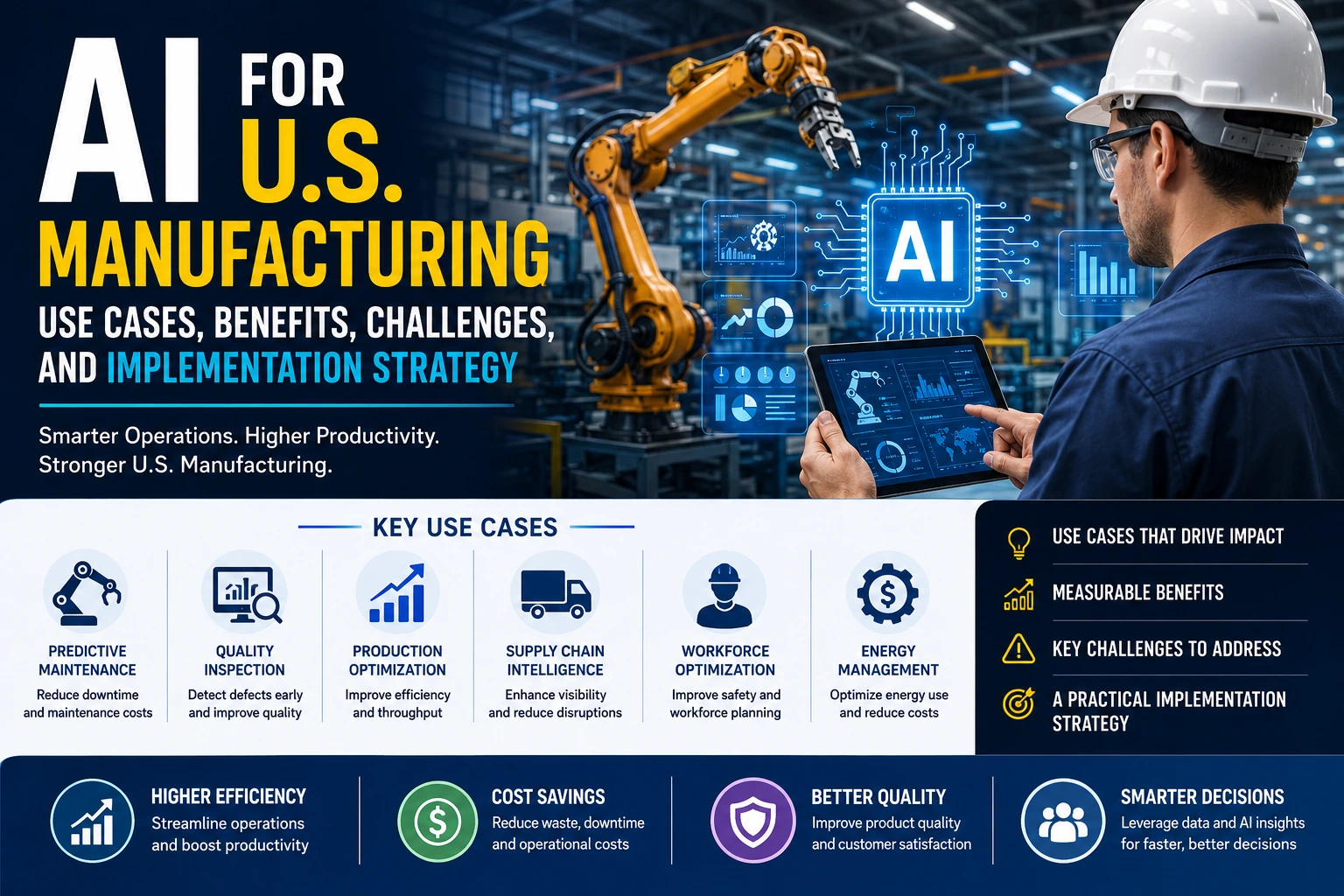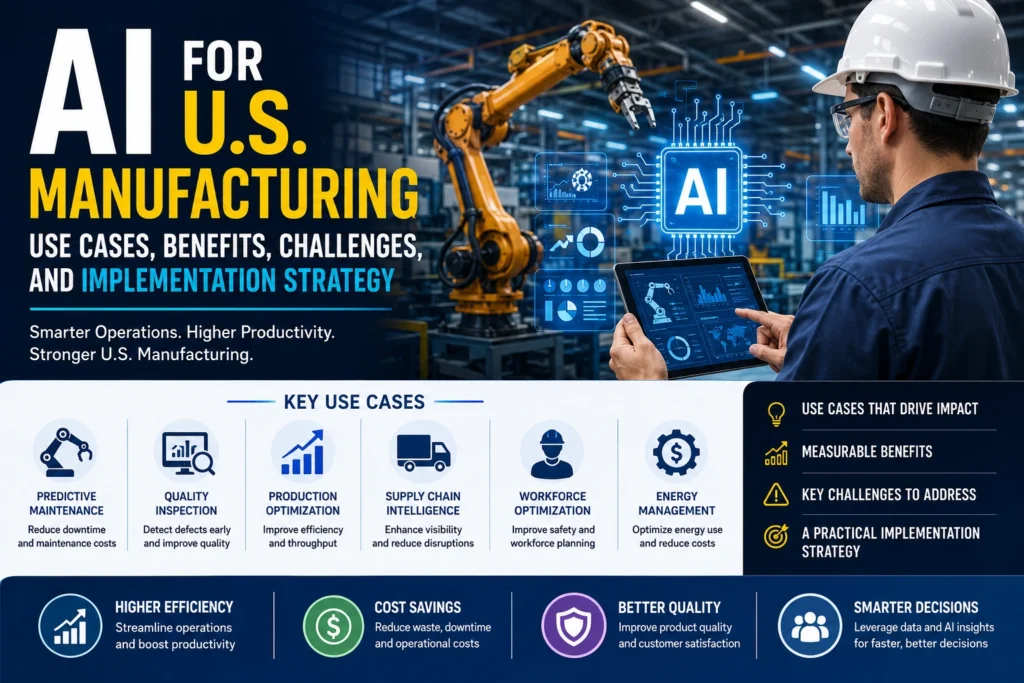
Artificial intelligence is reshaping the future of U.S. manufacturing. Manufacturers are using AI to improve production efficiency, predict equipment failures, identify product defects, optimize supply chains, support product design, and make faster data-driven decisions.
According to the U.S. National Institute of Standards and Technology (NIST), AI is already being used across U.S. manufacturing, with applications ranging from predictive maintenance and quality control to production planning, robotics, digital twins, and resource optimization. NIST also reports that more than 80% of manufacturers surveyed expect to increase their use of AI over the next two years.
However, implementing AI in a manufacturing environment requires more than deploying an AI model. Manufacturers must consider data quality, legacy equipment, operational technology (OT), cybersecurity, workforce readiness, interoperability, safety, and return on investment.
For manufacturers, the real opportunity is to use AI where it can solve measurable production and business problems.
What Is AI for U.S. Manufacturing?
AI for U.S. manufacturing refers to the use of artificial intelligence, machine learning, computer vision, generative AI, robotics, predictive analytics, digital twins, and related technologies to improve manufacturing processes and decision-making.
AI can analyze large volumes of data from machines, sensors, production systems, enterprise applications, supply chains, and quality-control processes.
Common applications include:
- Predictive maintenance
- Automated quality inspection
- Production optimization
- Demand forecasting
- Inventory optimization
- Supply-chain management
- AI-powered robotics
- Computer vision
- Digital twins
- Generative design
- Production scheduling
- Energy optimization
- Worker assistance
- Manufacturing analytics
- Engineering support
The objective is not simply to automate manufacturing. The objective is to create more efficient, responsive, resilient, and data-driven manufacturing operations.
Why Is AI Important for U.S. Manufacturers?
Manufacturers in the United States operate in a highly competitive environment where productivity, quality, workforce availability, supply-chain resilience, and operational efficiency directly affect business performance.
AI can help manufacturers analyze operational data faster and identify patterns that may be difficult to detect through manual processes alone.
NIST’s current manufacturing AI research emphasizes reliable, resilient, and interoperable AI systems and highlights the importance of measurement science, standards, and effective human-AI collaboration.
AI can potentially help manufacturers:
- Reduce unplanned downtime
- Improve product quality
- Increase production visibility
- Optimize manufacturing processes
- Improve forecasting
- Support workers
- Reduce repetitive administrative tasks
- Improve asset utilization
- Strengthen operational decision-making
- Build more responsive supply chains
Top AI Use Cases in U.S. Manufacturing
1. Predictive Maintenance
Predictive maintenance is one of the most practical applications of AI in manufacturing.
Manufacturing equipment produces large amounts of information through sensors and machine systems. AI can analyze this data to identify patterns associated with equipment degradation or potential failures.
Instead of relying exclusively on fixed maintenance schedules, manufacturers can use predictive insights to determine when equipment may require inspection or maintenance.
Potential benefits include:
- Reduced unplanned downtime
- Better maintenance planning
- Improved equipment availability
- More efficient use of maintenance resources
- Improved asset lifecycle management
NIST’s manufacturing research specifically focuses on combining AI with measurement and physics-based approaches to monitor and predict machine and process performance.
2. AI-Powered Quality Control
Quality control is another major application of AI.
Computer vision systems can analyze images from production lines and identify defects, inconsistencies, or anomalies.
AI-based inspection can be applied to:
- Surface defects
- Assembly errors
- Product dimensions
- Packaging
- Component placement
- Material inconsistencies
- Manufacturing anomalies
AI does not necessarily replace human quality professionals. Instead, it can provide another layer of inspection and help teams identify issues earlier.
3. Computer Vision in Manufacturing
Computer vision enables machines to interpret visual information.
Manufacturers can use AI-powered cameras to monitor production lines, inspect products, track materials, and support workplace processes.
Potential applications include:
- Automated inspection
- Defect detection
- Assembly verification
- Inventory monitoring
- Object detection
- Safety monitoring
- Process monitoring
Computer vision can be particularly valuable when manufacturers need to inspect large numbers of products consistently.
4. AI for Production Optimization
Manufacturing processes often involve multiple variables, including machine settings, production sequences, materials, labor, environmental conditions, and product specifications.
AI can analyze historical and real-time information to identify relationships between these variables.
Potential applications include:
- Process parameter optimization
- Production-line balancing
- Throughput optimization
- Yield improvement
- Bottleneck identification
- Production planning
The goal is to help manufacturers make informed adjustments based on operational data rather than relying exclusively on manual analysis.
5. AI for Supply Chain Management
Supply-chain disruptions can have a significant impact on manufacturing operations.
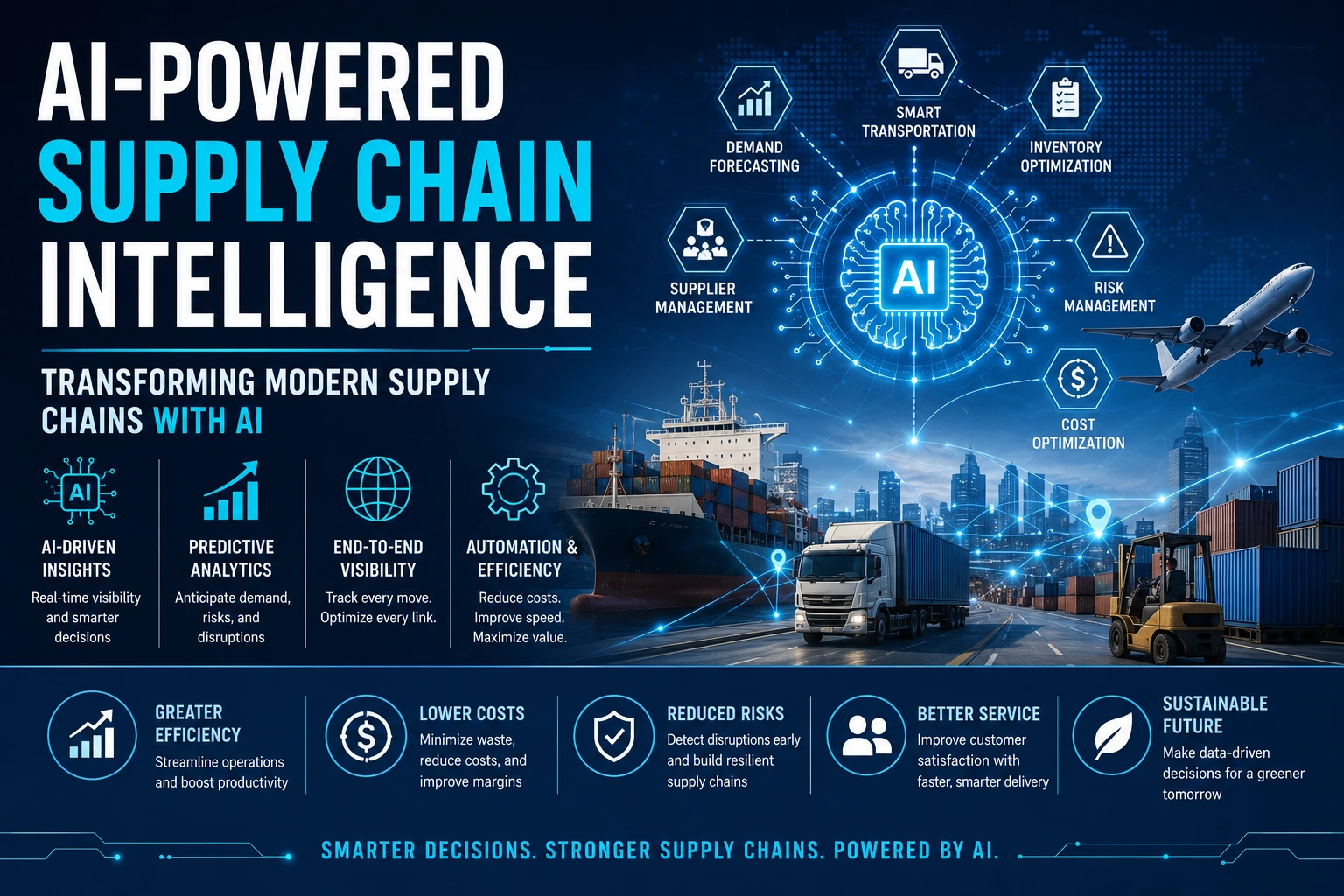
AI can analyze demand, inventory, supplier, logistics, and production information to support supply-chain planning.
Potential applications include:
- Demand forecasting
- Inventory optimization
- Supplier analysis
- Logistics optimization
- Material planning
- Disruption prediction
- Procurement analytics
AI can help manufacturers respond more quickly when market conditions or supply requirements change.
6. Digital Twins and AI
A digital twin is a digital representation of a physical asset, process, or system.
When combined with AI, digital twins can support simulation, monitoring, optimization, and predictive analysis.
Manufacturers can use digital twins to explore scenarios before making changes to physical production systems.
Potential applications include:
- Equipment simulation
- Production-process optimization
- Predictive maintenance
- Product development
- Factory planning
- Lifecycle analysis
NIST’s 2026 roadmap identifies digital twins as one of the important areas where AI and machine learning are advancing smart manufacturing.
7. Generative AI for Manufacturing
Generative AI is creating new opportunities beyond traditional predictive models.
Manufacturers can explore generative AI for:
- Technical documentation
- Engineering knowledge retrieval
- Maintenance assistance
- Production reporting
- Internal knowledge management
- Product design support
- Employee training
- Data analysis
- Natural-language interfaces for manufacturing information
For example, an AI assistant could help an authorized employee find information across approved equipment manuals, maintenance documentation, standard operating procedures, and internal knowledge bases.
However, manufacturing organizations should implement appropriate access controls, validation, cybersecurity measures, and human review.
8. AI-Powered Robotics
AI is also changing industrial robotics.
Traditional automation generally follows predefined instructions. AI-enabled robotics can incorporate perception, learning, adaptation, and decision-making capabilities.
Applications may include:
- Intelligent assembly
- Material handling
- Autonomous navigation
- Robotic inspection
- Human-robot collaboration
- Adaptive manufacturing
NIST’s current work also highlights physical AI, human-AI teaming, and autonomous systems as emerging areas for manufacturing.
9. AI for Energy Optimization
Manufacturing facilities can consume significant amounts of energy.
AI can analyze energy consumption patterns and identify opportunities for optimization.
Potential applications include:
- Energy forecasting
- Equipment optimization
- Production scheduling
- Peak-load management
- Facility monitoring
- Process efficiency
This can help manufacturers pursue both operational and sustainability objectives.
Benefits of AI for U.S. Manufacturing
Improved Operational Efficiency
AI can analyze production information and help identify inefficiencies, bottlenecks, and opportunities for process improvement.
Reduced Downtime
Predictive maintenance can provide earlier indications of potential equipment problems, allowing maintenance teams to plan interventions.
Better Quality
Computer vision and AI-based anomaly detection can support consistent inspection and early identification of manufacturing defects.
Faster Decision-Making
AI can transform large amounts of operational information into dashboards, predictions, alerts, summaries, or recommendations.
Improved Supply-Chain Visibility
AI can help manufacturers analyze demand, inventory, suppliers, and logistics to support better planning.
Workforce Augmentation
AI can assist employees with repetitive analysis, information retrieval, documentation, and operational decision-making.
Greater Manufacturing Resilience
AI can support more responsive production and supply-chain operations by helping manufacturers identify changing conditions earlier.
AI Adoption Challenges in U.S. Manufacturing
AI offers significant opportunities, but manufacturers face several barriers to successful implementation.
NIST identifies challenges including data quality and availability, implementation costs, workforce skills, privacy and cybersecurity risks, and integration with legacy systems.
1. Legacy Manufacturing Systems
Many factories operate equipment and software introduced years or even decades ago.
Connecting modern AI solutions with legacy systems can be technically challenging.
Manufacturers may need integration layers, APIs, industrial gateways, data historians, or other technologies to connect operational data with modern AI platforms.
2. Data Quality
AI is highly dependent on data.
Manufacturing data can be:
- Incomplete
- Inconsistent
- Distributed across systems
- Poorly labeled
- Difficult to access
- Collected at different frequencies
Before deploying AI, organizations should assess the quality and availability of the data required for the specific use case.
3. Cybersecurity
Manufacturing environments contain both IT and OT systems.
Connecting production equipment to AI platforms can create additional security considerations.
Manufacturers should consider:
- Network segmentation
- Identity and access management
- Data encryption
- Monitoring
- Vendor security
- Endpoint protection
- Secure APIs
- Incident response
4. Workforce Skills
AI adoption requires people who understand both manufacturing and technology.
Organizations may need expertise in:
- Data engineering
- Machine learning
- Industrial automation
- Cybersecurity
- Cloud platforms
- OT systems
- AI governance
- Manufacturing processes
Workforce development is therefore an important part of AI transformation.
5. Return on Investment
AI projects require investment in technology, data infrastructure, integration, implementation, and employee training.
Manufacturers should define measurable business outcomes before starting a project.
Instead of asking only:
“Can we use AI?”
manufacturers should ask:
“What measurable manufacturing problem can AI solve, and how will we prove that it created value?”
How to Implement AI in a U.S. Manufacturing Company
Successful AI adoption should be approached as a structured transformation rather than a technology experiment.
Step 1: Identify a Specific Business Problem
Start with a measurable challenge.
Examples include:
- High machine downtime
- Excessive scrap
- Quality inconsistencies
- Poor demand forecasting
- Manual inspection
- Inefficient scheduling
- High energy consumption
Step 2: Assess Data Readiness
Determine what data exists and whether it is suitable for the proposed AI application.
Review:
- Data sources
- Data quality
- Data ownership
- Data availability
- Sensor coverage
- Historical records
- Integration requirements
Step 3: Select the Appropriate AI Technology
Not every manufacturing problem requires generative AI.
Depending on the use case, the appropriate technology could be:
- Machine learning
- Computer vision
- Predictive analytics
- Generative AI
- Digital twins
- Robotics
- Optimization algorithms
The technology should follow the business requirement.
Step 4: Build a Proof of Concept
A controlled proof of concept can help determine whether the proposed AI approach works with real manufacturing data.
The POC should have measurable objectives.
For example:
- Reduce inspection time
- Improve defect detection
- Predict machine failures
- Reduce material waste
- Improve production forecasting
Step 5: Integrate AI With Existing Systems
A successful AI solution needs to work with the manufacturer’s technology environment.
Depending on the organization, integration may involve:
- ERP systems
- MES platforms
- SCADA systems
- PLCs
- IoT platforms
- CRM systems
- Data warehouses
- Cloud platforms
Step 6: Establish Human Oversight
AI should be integrated with appropriate human review, particularly when incorrect decisions could affect worker safety, product quality, equipment, or production continuity.
NIST’s current AI-for-manufacturing work emphasizes the importance of measuring and improving human-AI teaming and developing reliable, resilient, interoperable systems.
Step 7: Measure Results
AI projects should be evaluated using clear KPIs.
Potential metrics include:
| Manufacturing Area | Example KPI |
|---|---|
| Maintenance | Unplanned downtime |
| Quality | Defect rate |
| Production | Throughput |
| Inventory | Inventory turnover |
| Supply Chain | Forecast accuracy |
| Labor | Time spent on repetitive tasks |
| Energy | Energy consumption per unit |
| Operations | Overall equipment effectiveness |
| Finance | Cost per unit |
| AI | Model performance |
The specific metrics should match the business case.
AI Governance for Manufacturing
AI governance is becoming increasingly important as manufacturers move from experimental AI projects to production environments.
A practical AI governance program can address:
- Data governance
- Cybersecurity
- Model validation
- AI performance
- Access control
- Human oversight
- Vendor management
- Documentation
- Monitoring
- Incident response
- Change management
Manufacturers should also consider whether an AI system interacts directly with physical equipment or production processes.
AI that influences a physical system can introduce different safety and reliability considerations than an AI tool used only for internal documentation.
AI and the Future of U.S. Manufacturing
The future of manufacturing AI is moving toward increasingly connected and intelligent systems.
NIST’s 2026 roadmap identifies several emerging directions, including:
- Generative AI
- Foundation models
- Large language models
- Digital twins
- Robotics
- Advanced sensing
- Supply-chain optimization
- Physics-informed AI
- Explainable AI
- Autonomous systems
- Human-AI teaming
The roadmap also emphasizes that industrial AI must become reliable, explainable, and trustworthy enough for high-stakes manufacturing environments.
This shift means manufacturers will increasingly need to combine AI with industrial engineering, automation, data infrastructure, cybersecurity, and domain expertise.
AI Is Not Replacing the Manufacturing Workforce
One of the most important aspects of AI adoption is the relationship between technology and people.
AI can automate certain tasks, but manufacturing still depends heavily on human knowledge and experience.
AI can help workers:
- Find information faster
- Detect potential problems
- Analyze production data
- Monitor equipment
- Improve decision-making
- Automate repetitive work
Manufacturing organizations should therefore view AI as a tool for human-AI collaboration rather than simply workforce replacement.
Training employees to understand, supervise, and effectively use AI systems can be just as important as deploying the technology itself.
Why U.S. Manufacturers Need a Practical AI Strategy
AI adoption should be aligned with the manufacturer’s broader business strategy.
A practical roadmap should answer:
- What manufacturing problem are we solving?
- What data do we need?
- What AI technology is appropriate?
- How will the solution integrate with existing systems?
- What security controls are required?
- Who owns the AI system?
- What level of human oversight is necessary?
- How will success be measured?
- How will the system be monitored after deployment?
- How can the solution scale across plants or production lines?
Answering these questions before implementation can reduce technology risk and improve the likelihood of achieving measurable business value.
How Performix Can Support AI for U.S. Manufacturing
AI transformation requires more than an AI model. Manufacturers need a technology partner that can understand business objectives, data, applications, integration requirements, and scalable digital architecture.
Performix can help organizations explore AI-enabled technology solutions designed around specific business and operational requirements.
A practical approach can include:
- AI strategy and consulting
- AI application development
- Data and analytics solutions
- Intelligent automation
- System integration
- Cloud-based technology solutions
- Custom software development
- AI-enabled business applications
- Ongoing technology support
The right AI strategy begins by identifying a real manufacturing challenge and determining whether AI can provide measurable value.
Frequently Asked Questions About AI for U.S. Manufacturing
What is AI in manufacturing?
AI in manufacturing is the use of artificial intelligence technologies such as machine learning, computer vision, predictive analytics, generative AI, robotics, and digital twins to improve production, quality, maintenance, supply chains, and decision-making.
How is AI used in U.S. manufacturing?
AI is used for predictive maintenance, automated quality inspection, production optimization, demand forecasting, supply-chain management, robotics, computer vision, digital twins, energy optimization, engineering support, and manufacturing analytics.
What are the biggest benefits of AI for manufacturers?
Key potential benefits include improved operational efficiency, reduced downtime, better quality control, faster decision-making, improved forecasting, increased production visibility, and more effective use of manufacturing resources.
What are the biggest challenges of AI adoption in manufacturing?
Common challenges include poor data quality, legacy-system integration, cybersecurity, implementation costs, workforce skills, interoperability, AI reliability, and uncertainty about return on investment.
Can AI reduce manufacturing downtime?
AI can support predictive maintenance by analyzing equipment and sensor data to identify patterns associated with potential failures. However, actual results depend on data quality, equipment, model performance, implementation, and maintenance processes.
How can AI improve manufacturing quality?
AI-powered computer vision and anomaly-detection systems can analyze production data or images to identify defects and inconsistencies. These systems can supplement existing quality-control processes.
Can generative AI be used in manufacturing?
Yes. Generative AI can support areas such as technical documentation, knowledge retrieval, maintenance assistance, reporting, employee training, engineering support, and natural-language access to approved manufacturing information.
How much does AI implementation cost for a manufacturing company?
There is no universal cost. Investment depends on the use case, data infrastructure, integration requirements, AI technology, number of facilities, security requirements, and implementation scope. A focused pilot is often a practical way to evaluate feasibility and potential ROI before a larger deployment.
Should manufacturers start with generative AI?
Not necessarily. The best starting technology depends on the business problem. Predictive machine learning may be more appropriate for equipment failure prediction, while computer vision may be better suited to automated inspection.
Is AI the future of U.S. manufacturing?
AI is likely to become an increasingly important component of smart manufacturing. Current NIST initiatives and research emphasize AI-driven productivity, intelligent manufacturing systems, robotics, digital twins, human-AI teaming, and reliable AI deployment.
Conclusion
AI for U.S. manufacturing is evolving from an emerging technology into an important component of smart manufacturing and industrial transformation.
From predictive maintenance and computer vision to generative AI, robotics, digital twins, supply-chain optimization, and intelligent automation, AI can help manufacturers improve how they operate, make decisions, manage assets, and respond to changing market conditions.
But successful implementation requires more than adopting the latest AI technology.
Manufacturers need high-quality data, secure infrastructure, effective integration, skilled employees, measurable objectives, appropriate governance, and continuous monitoring.
The most successful approach is to start with a clear manufacturing problem, select the right technology, validate the solution through measurable outcomes, and then scale what works.
For U.S. manufacturers, the future is not simply about making factories more automated.
It is about building smarter, more connected, resilient, and human-centered manufacturing systems powered by data and responsible AI.