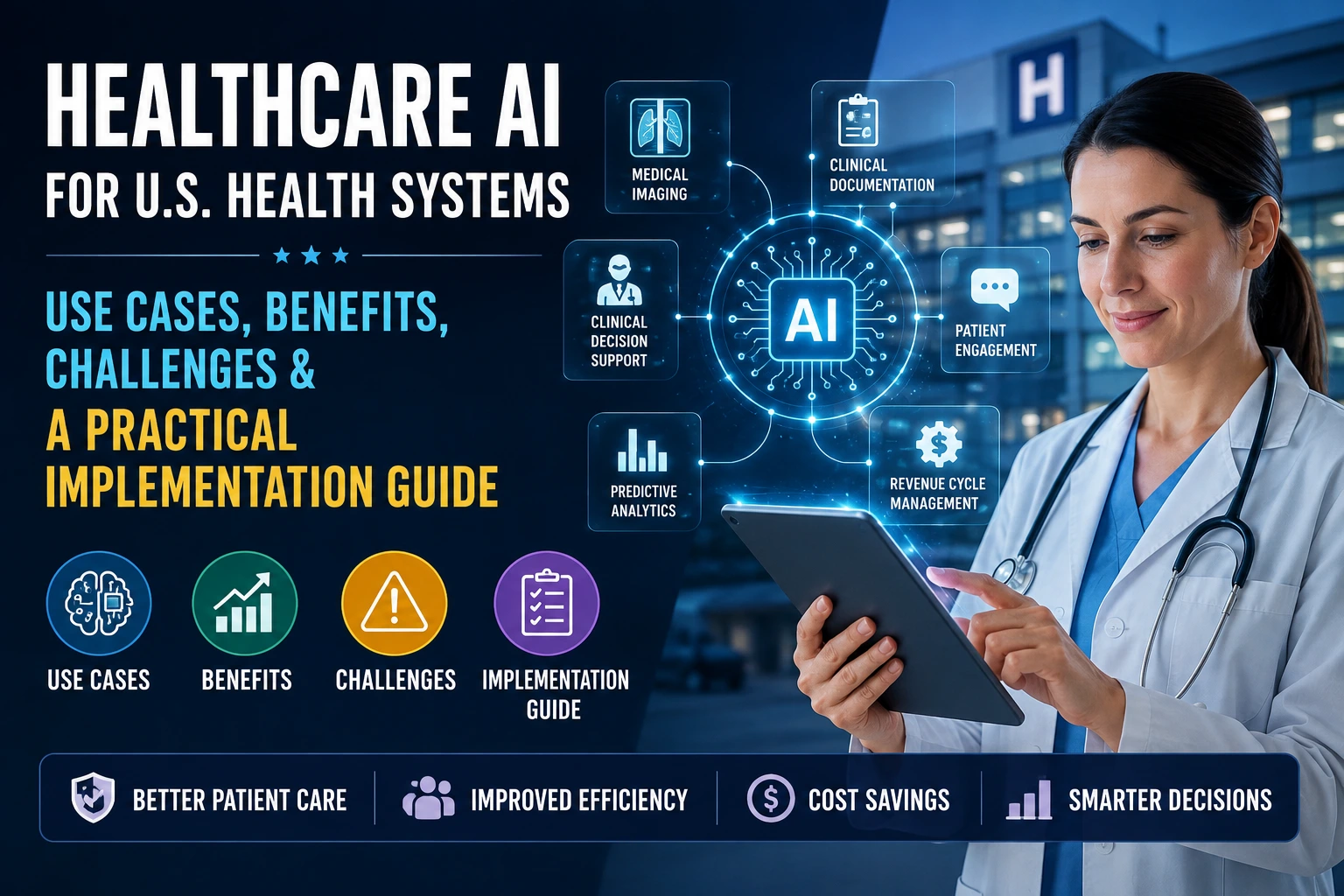
Artificial intelligence is becoming an important part of healthcare delivery in the United States. From clinical decision support and medical imaging to documentation, patient engagement, revenue cycle management, and hospital operations, AI can help health systems improve efficiency while supporting better-informed decisions.
However, implementing healthcare AI for U.S. health systems is not simply a matter of purchasing an AI platform. Successful adoption requires reliable data, interoperability, cybersecurity, clinical validation, responsible governance, regulatory awareness, and strong collaboration between technology teams and healthcare professionals.
For U.S. health systems, the most valuable AI strategy is therefore not “AI everywhere.” It is the right AI, connected to the right workflow, with the right safeguards.
What Is Healthcare AI for U.S. Health Systems?
Healthcare AI refers to artificial intelligence technologies used to support healthcare organizations, clinicians, administrative teams, and patients. These technologies can include machine learning, natural language processing, computer vision, predictive analytics, generative AI, and large language models.
For a U.S. health system, AI can be integrated into areas such as:
- Clinical decision support
- Medical imaging and diagnostics
- Clinical documentation
- Patient communication
- Hospital workflow optimization
- Predictive analytics
- Revenue cycle management
- Population health management
- Care coordination
- Healthcare research
- Staff and resource management
The objective is not necessarily to replace healthcare professionals. Instead, well-designed AI solutions can automate repetitive work, surface relevant information, identify patterns, and provide decision support while keeping qualified professionals involved in important clinical and operational decisions.
Why Are U.S. Health Systems Investing in AI?
Healthcare organizations manage enormous volumes of structured and unstructured information. Electronic health records, medical images, laboratory results, clinical notes, claims, patient messages, and operational data can be difficult to analyze efficiently using traditional systems.
AI can help transform this information into actionable insights.
For example, an AI system may analyze clinical information to identify patients who could require additional attention, summarize large amounts of documentation, assist with medical image analysis, or help administrative teams identify workflow bottlenecks.
At the same time, AI adoption introduces new responsibilities. Health systems must consider accuracy, privacy, cybersecurity, bias, explainability, human oversight, and ongoing monitoring.
The U.S. Office of the National Coordinator for Health Information Technology (ONC) has already established algorithm-transparency requirements for certain AI and predictive algorithms within certified health IT through the HTI-1 Final Rule. The rule emphasizes information that can help users evaluate algorithms for characteristics including validity, effectiveness, fairness, appropriateness, and safety.
Key Healthcare AI Use Cases for U.S. Health Systems
1. Clinical Decision Support
AI can assist clinicians by analyzing relevant patient information and presenting risk indicators, patterns, or recommendations within existing workflows.
Examples include:
- Risk prediction
- Clinical alerts
- Patient deterioration monitoring
- Medication-related insights
- Care pathway support
- Diagnostic assistance
The key principle is that AI-generated information should support—not automatically replace—clinical judgment.
2. AI-Powered Medical Imaging
Computer vision and machine learning can assist with the analysis of medical images such as X-rays, CT scans, MRIs, ultrasounds, and other diagnostic studies.
AI-enabled medical devices are already an established area of U.S. healthcare technology. The FDA maintains an AI-Enabled Medical Device List containing devices that have received applicable marketing authorization. The FDA also emphasizes that the list is not comprehensive.
For health systems, implementation should focus on:
- Intended clinical use
- Validation
- Workflow integration
- Appropriate clinician oversight
- Performance monitoring
- Patient safety
3. Clinical Documentation and Ambient AI
One of the most practical applications of generative AI is assisting with clinical documentation.
AI-enabled documentation tools can potentially help capture conversations, generate structured notes, summarize information, and reduce manual administrative work.
A successful implementation should consider:
- Accuracy of generated documentation
- Clinician review
- Patient privacy
- Consent requirements where applicable
- Integration with the EHR
- Auditability
- Error correction workflows
The goal should be to reduce administrative burden without introducing new documentation risks.
4. Patient Engagement
Healthcare AI can also support communication between health systems and patients.
Potential applications include:
- Frequently asked questions
- Appointment assistance
- Patient education
- Navigation of healthcare services
- Medication reminders
- Administrative support
- Multilingual communication
Generative AI systems used for patient-facing interactions require particularly strong safeguards. A healthcare organization should ensure that the system knows its boundaries and can escalate complex or urgent situations to an appropriate human professional.
5. Predictive Analytics and Population Health
Health systems can use predictive models to identify trends across patient populations.
Potential applications include:
- Readmission risk
- Chronic disease management
- Patient outreach
- Capacity planning
- Resource utilization
- Population health analysis
However, predictive performance can change when a model is deployed in a new population or environment. Health systems should therefore evaluate models using data and workflows representative of their own organization.
6. Hospital Operations and Resource Optimization
AI does not have to be limited to clinical applications.
Operational AI can support:
- Bed management
- Staffing
- Scheduling
- Patient flow
- Appointment forecasting
- Supply chain management
- Operating room utilization
- Emergency department workflow
These use cases can provide measurable operational value while generally presenting different risk considerations from AI directly involved in clinical decision-making.
7. Revenue Cycle and Administrative Automation
Healthcare organizations also have significant administrative workloads.
AI can assist with:
- Claims-related workflows
- Document classification
- Prior authorization support
- Coding assistance
- Eligibility workflows
- Revenue cycle analytics
- Administrative correspondence
Human review remains important for workflows where incorrect information could create financial, compliance, or patient-care consequences.
What Are the Benefits of Healthcare AI?
When appropriately designed and governed, healthcare AI can provide several potential benefits for U.S. health systems.
Improved Operational Efficiency
AI can automate repetitive tasks and help employees process large amounts of information more efficiently.
This may allow clinical and administrative professionals to spend more time on higher-value activities.
Better Access to Information
AI can organize and summarize complex information, helping authorized users find relevant data more quickly.
Support for Clinical Decisions
AI can identify patterns and provide decision-support information that clinicians can consider alongside medical knowledge, patient context, and professional judgment.
Personalized Patient Experiences
AI can help health systems deliver more relevant communication and support based on patient needs, preferences, and available information.
Scalable Healthcare Operations
AI-based automation can help organizations manage increasing volumes of administrative and operational work without relying exclusively on manual processes.
What Are the Risks of AI in Healthcare?
Healthcare AI has significant potential, but it also carries meaningful risks.
Health systems should evaluate AI systems before and after deployment rather than assuming that a model will remain accurate simply because it performed well during development.
Common risks include:
Algorithmic bias:
AI models can produce different results across populations if development or evaluation data does not adequately represent the patients served.
Incorrect outputs:
Generative AI can produce inaccurate or misleading information, sometimes with high confidence.
Privacy risks:
Healthcare organizations must protect sensitive patient information and establish appropriate data-access controls.
Cybersecurity risks:
AI systems introduce additional software, data, integration, and infrastructure considerations.
Model drift:
Performance can change as patient populations, clinical practices, data sources, or workflows change.
Lack of transparency:
Clinicians and administrators need enough information about an AI system to understand its intended use, limitations, and performance.
Workflow disruption:
A technically capable AI product can still fail if it creates additional work or does not fit naturally into clinical workflows.
AI Governance Is Essential for U.S. Health Systems
AI governance should be treated as an ongoing organizational capability rather than a one-time approval process.
A health system’s AI governance framework may include representatives from:
- Clinical leadership
- IT
- Data science
- Cybersecurity
- Compliance
- Legal
- Privacy
- Quality and patient safety
- Health information management
- Operations
- Procurement
The governance process should define who can approve AI systems, what evidence is required, how performance will be monitored, and what happens when an AI system produces unacceptable results.
What Should an AI Governance Framework Include?
A practical framework can address:
- Intended use
- Risk classification
- Data sources
- Privacy requirements
- Security controls
- Clinical validation
- Bias and fairness evaluation
- Performance benchmarks
- Human oversight
- User training
- Audit logging
- Incident response
- Ongoing monitoring
- Change management
- Retirement or replacement criteria
ONC’s HTI-1 framework is particularly relevant to health IT environments because it introduced transparency requirements for certain predictive decision-support technologies in certified health IT.
Healthcare AI and U.S. Regulatory Considerations
Regulatory requirements depend on what an AI system does, how it is used, what data it processes, and whether it qualifies as a regulated medical device or interacts with certified health IT.
Organizations should not assume that every AI application is regulated in the same way.
For AI-enabled medical devices, the FDA maintains resources describing authorized AI-enabled devices and continues to develop its regulatory approach as AI technology evolves. In August 2026, the FDA published a discussion paper seeking feedback on regulatory considerations for generative AI-enabled medical devices, including risk assessment, premarket evaluation, and postmarket monitoring.
The FDA’s digital health guidance landscape also includes a final Clinical Decision Support Software guidance issued in January 2026 and guidance concerning AI-enabled device software functions and lifecycle management.
For health systems, this means AI procurement and deployment should include regulatory and compliance review appropriate to the specific use case.
How to Implement AI in a U.S. Health System
A successful healthcare AI implementation should begin with the problem—not the technology.
Step 1: Identify a High-Value Problem
Instead of asking, “Where can we use AI?”, ask:
“Which healthcare workflow has a measurable problem that AI could realistically improve?”
Potential criteria include:
- High administrative burden
- Repetitive manual processes
- Long turnaround times
- Data-intensive workflows
- Clear performance metrics
- Strong availability of quality data
Step 2: Assess Data Readiness
AI depends heavily on data quality.
Before deployment, assess:
- Data completeness
- Data accuracy
- Data availability
- Interoperability
- Data lineage
- Access controls
- Patient matching
- Historical consistency
Poor-quality data can lead to poor-quality AI outcomes.
Step 3: Evaluate the AI Solution
A health system should evaluate more than marketing claims.
Consider:
- Accuracy
- Sensitivity and specificity where appropriate
- False-positive and false-negative rates
- Population performance
- Explainability
- Security
- Integration capabilities
- Vendor transparency
- Monitoring capabilities
- Regulatory status where applicable
Step 4: Integrate AI Into Existing Workflows
An AI tool should fit naturally into the environment where healthcare professionals already work.
For example, an AI recommendation that requires clinicians to leave the EHR, open another application, and manually transfer information may create friction rather than efficiency.
Interoperability and workflow design are therefore critical.
Step 5: Start With a Controlled Pilot
A pilot allows the organization to evaluate real-world performance before broader deployment.
Define success metrics before launching.
Possible metrics include:
- Time saved
- Documentation turnaround
- User adoption
- Error rates
- Patient experience
- Clinical workflow impact
- Operational cost
- Model performance
Step 6: Establish Human Oversight
Human oversight should be proportional to the risk of the use case.
For high-impact clinical applications, AI outputs should not automatically become clinical decisions without appropriate professional review.
Step 7: Monitor After Deployment
AI governance does not end after implementation.
Organizations should continuously monitor:
- Accuracy
- Bias
- Model drift
- User behavior
- Security
- Data changes
- Unexpected outputs
- Clinical incidents
- Operational performance
Healthcare AI Integration With EHR Systems
EHR integration is one of the most important technical considerations for health systems.
AI solutions may need to interact with information from systems such as:
- Electronic health records
- Laboratory systems
- Imaging systems
- Pharmacy systems
- Scheduling platforms
- Claims systems
- Patient engagement platforms
Interoperability standards and APIs can help connect systems, but integration should be designed around security, authorization, data quality, and workflow requirements.
For U.S. health systems, interoperability is also closely connected to the broader health IT ecosystem. ONC’s HTI-1 Final Rule includes updates related to interoperability, information sharing, algorithm transparency, and the U.S. Core Data for Interoperability.
Generative AI vs. Traditional AI in Healthcare
Traditional AI and generative AI can serve different purposes.
Traditional AI often focuses on prediction, classification, detection, or optimization.
Examples include:
- Predicting patient risk
- Classifying medical images
- Forecasting demand
- Detecting patterns
Generative AI creates new content based on input data.
Examples include:
- Summarizing clinical information
- Drafting documentation
- Generating patient communication
- Answering questions
- Supporting information retrieval
Generative AI can be highly useful, but its ability to generate fluent responses does not guarantee factual accuracy.
For this reason, health systems should implement safeguards such as approved data sources, retrieval mechanisms, access controls, human review, monitoring, and clear escalation paths.
How to Measure the ROI of Healthcare AI
Healthcare organizations should avoid measuring AI success solely by the number of models deployed.
Instead, measure business, operational, clinical, and user outcomes.
A healthcare AI ROI framework may include:
| Measurement Area | Example KPI |
|---|---|
| Productivity | Staff hours saved |
| Documentation | Documentation time per encounter |
| Operations | Turnaround time |
| Patient Experience | Patient satisfaction |
| Clinical Workflow | Time to review relevant information |
| Financial | Administrative cost reduction |
| Adoption | Active user rate |
| Quality | Error or exception rate |
| Safety | AI-related incidents |
| Model Performance | Accuracy and other relevant metrics |
The appropriate KPI depends on the AI use case.
Common Healthcare AI Implementation Mistakes
Choosing AI Before Defining the Problem
Technology should solve a business or clinical problem rather than become an objective by itself.
Ignoring Workflow Design
Even an accurate model can fail if clinicians or staff cannot use it efficiently.
Treating Pilot Results as Permanent
AI performance should be evaluated continuously because data and operating environments change.
Underestimating Change Management
Healthcare professionals need training, communication, and a clear understanding of how AI affects their work.
Failing to Establish Ownership
Every AI deployment should have a clearly identified business or clinical owner.
Using AI Without Appropriate Governance
Privacy, security, compliance, safety, fairness, and monitoring should be addressed before deployment—not after a problem occurs.
What Should U.S. Health Systems Look for in an AI Technology Partner?
Choosing an AI technology partner requires more than reviewing technical capabilities.
Health systems should look for a partner that understands:
- Healthcare workflows
- Data security
- Interoperability
- AI lifecycle management
- Cloud and infrastructure architecture
- Application development
- Data engineering
- Model evaluation
- User experience
- Regulatory considerations
- Ongoing support
The right partner should be able to translate a healthcare organization’s operational or clinical challenge into a practical technology roadmap.
The Future of Healthcare AI in the United States
The next stage of healthcare AI will likely move beyond isolated tools toward more integrated AI capabilities across clinical, administrative, and operational workflows.
Generative AI, multimodal systems, predictive analytics, intelligent automation, and AI-enabled medical devices will continue to evolve.
However, successful adoption will depend on trust.
Health systems will need AI solutions that are:
Useful. Secure. Interoperable. Transparent. Measurable. Governed. Human-centered.
The organizations that build these capabilities systematically will be better positioned to scale AI responsibly.
How Performix Can Help U.S. Health Systems With AI
Implementing healthcare AI requires a combination of technology expertise, healthcare workflow understanding, integration capabilities, and responsible engineering practices.
Performix can support organizations looking to explore and implement AI-enabled digital solutions across their technology environment.
From AI strategy and application development to data integration, automation, and scalable technology architecture, the right approach begins with understanding the organization’s specific business and healthcare objectives.
For health systems considering AI adoption, the first step should not be choosing a model. It should be identifying a meaningful problem, defining measurable outcomes, assessing data readiness, and designing an implementation strategy that keeps security, governance, and human oversight at the center.
Frequently Asked Questions About Healthcare AI for U.S. Health Systems
What is healthcare AI?
Healthcare AI is the use of artificial intelligence technologies such as machine learning, natural language processing, computer vision, predictive analytics, and generative AI to support healthcare delivery, operations, administration, and patient engagement.
How can AI help U.S. health systems?
AI can help U.S. health systems with clinical decision support, medical imaging, documentation, patient engagement, predictive analytics, hospital operations, revenue cycle workflows, and administrative automation.
Is AI safe to use in healthcare?
AI safety depends on the specific technology, use case, data, validation process, governance framework, and level of human oversight. Healthcare organizations should evaluate AI systems before deployment and monitor them continuously after implementation.
Does healthcare AI replace doctors and nurses?
AI is generally most valuable when it augments healthcare professionals rather than replacing clinical judgment. The appropriate level of human oversight depends on the specific use case and associated risk.
How can hospitals implement AI successfully?
Hospitals can begin by identifying a high-value problem, assessing data readiness, evaluating potential solutions, establishing governance, running a controlled pilot, integrating the technology into existing workflows, training users, and continuously monitoring performance.
What is AI governance in healthcare?
AI governance is the framework an organization uses to manage the responsible development, procurement, deployment, monitoring, and retirement of AI systems. It can cover privacy, security, fairness, validation, clinical safety, regulatory requirements, accountability, and performance monitoring.
What is generative AI in healthcare?
Generative AI uses models capable of producing content such as text, summaries, responses, or other outputs. In healthcare, potential applications include clinical documentation, information summarization, patient communication, and administrative assistance.
Why is EHR integration important for healthcare AI?
EHR integration allows AI applications to work with relevant clinical and operational information within existing healthcare workflows. Effective integration can reduce workflow friction while improving access to appropriate information.
How should health systems measure healthcare AI success?
Health systems should measure AI using use-case-specific metrics such as productivity, turnaround time, user adoption, documentation efficiency, operational cost, patient experience, quality, safety, and model performance.
Conclusion
Healthcare AI for U.S. health systems is no longer simply a technology experiment. It is becoming a strategic capability that can influence clinical workflows, administrative operations, patient engagement, and healthcare delivery.
But successful AI adoption requires more than advanced algorithms.
Health systems need reliable data, secure architecture, interoperability, clinical and operational validation, responsible governance, regulatory awareness, human oversight, and measurable outcomes.
The organizations that approach AI as a long-term transformation program—not a collection of disconnected tools—can build a stronger foundation for responsible innovation.
For U.S. health systems, the future of AI should not be about replacing the human element of healthcare. It should be about using technology responsibly to give healthcare professionals better information, better tools, and more time to focus on the people they serve.