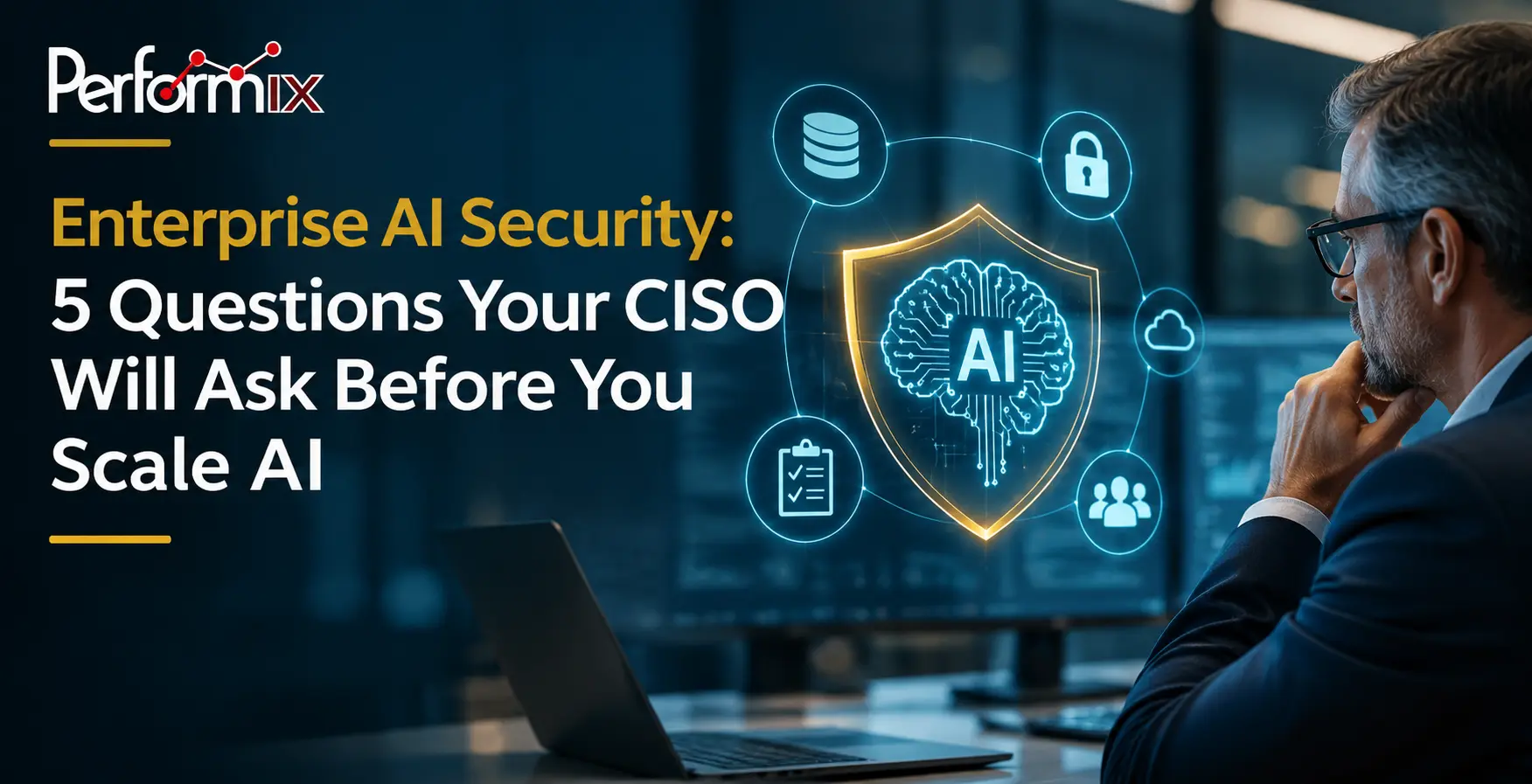
Before moving AI from successful pilots to production, CIOs, CISOs and CTOs need answers in five areas: data security, AI application protection, model reliability, vendor dependency and governance.
Key takeaways
- AI adoption is moving faster than security and governance readiness, according to recent Gartner and PwC research.
- Five questions separate a promising pilot from a production-ready deployment: Where does our data go? What can the AI do? Is it reliable? What if the vendor changes? Can we prove it’s governed?
- You don’t need to solve everything at once. Start with your highest-risk use case and put the right controls in place before you expand.
An AI pilot can show impressive results in a controlled environment.
An AI assistant retrieves information from internal documents. An AI agent automates repetitive workflows. A generative AI application helps employees analyze business information in minutes instead of hours.
The business case looks promising, and leadership wants to expand deployment.
But scaling AI across an enterprise brings a different set of challenges. Who can access the data? What happens when an AI agent takes an action nobody approved? Can the organization trust its outputs? What if its AI vendor changes pricing, retires a model or shuts down?
These are not questions to postpone until after deployment. Technology and security leaders need to answer them before AI is embedded in critical business operations.
The 2026 enterprise AI reality: adoption is moving faster than readiness
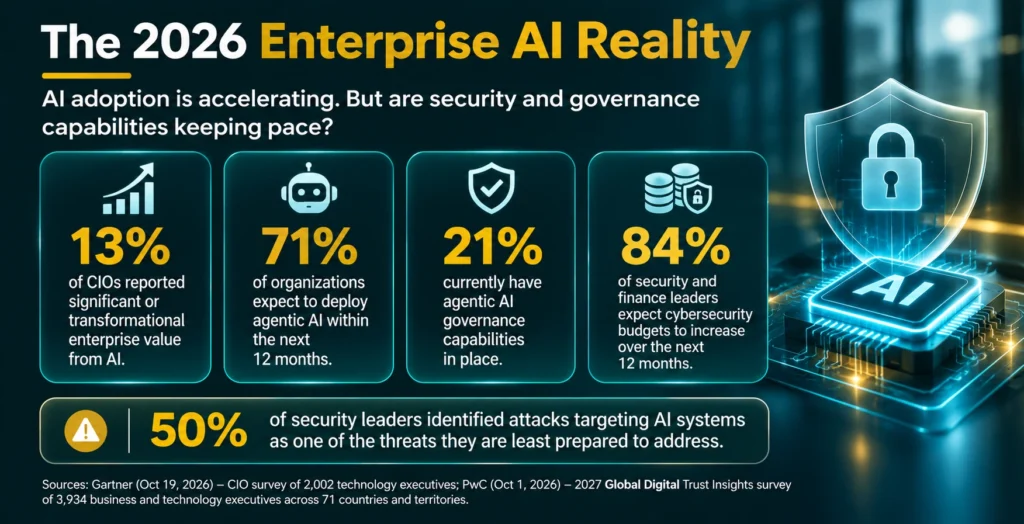
Recent research shows a growing gap between AI ambition and enterprise execution.
- 13%: Only 13% of CIOs said their enterprises had realized significant or transformational value from AI, according to Gartner’s survey of 2,002 CIOs and technology executives, conducted May to July 2026 and announced on October 19, 2026.
- 71% vs. 21%: Gartner also reported that 71% of organizations expect to deploy agentic AI within the next 12 months, while only 21% currently have agentic AI governance capabilities in place.
- 84%: In PwC’s 2027 Global Digital Trust Insights survey, 84% of security and finance leaders expected their cybersecurity budgets to increase over the next 12 months, up from 78% the year before.
- 50%: In the same PwC survey, half of security leaders identified attacks targeting AI systems as one of the threats their organizations are least prepared to address.
These are global surveys, not US-only studies. PwC’s covered 3,934 business and technology executives across 71 countries and territories. But the pattern is clear: AI investment is growing, while the security, governance and operational capabilities needed to scale it responsibly are still catching up.
Sources: Gartner, October 19, 2026 and Gartner keynote release; PwC, October 1, 2026.
1. Where does our enterprise data go when AI processes it?
The CISO’s concern: Can we protect sensitive business information across the entire AI data lifecycle?
Enterprise AI systems often interact with information that organizations cannot afford to expose.
Consider a company that connects an AI assistant to its internal knowledge base. Employees may use it to retrieve customer information, financial reports, employee records, operational documents and proprietary business information.
But what happens when an employee retrieves a document they aren’t authorized to see? What happens when sensitive information ends up in a prompt sent to an external model provider?
The problem isn’t limited to the model. It extends across the whole data flow: users, applications, retrieval systems, databases, model providers and connected services.
What should technology leaders evaluate?
1. Data classification. Identify what information is public, internal, confidential or restricted. Apply appropriate controls before connecting business data to AI applications.
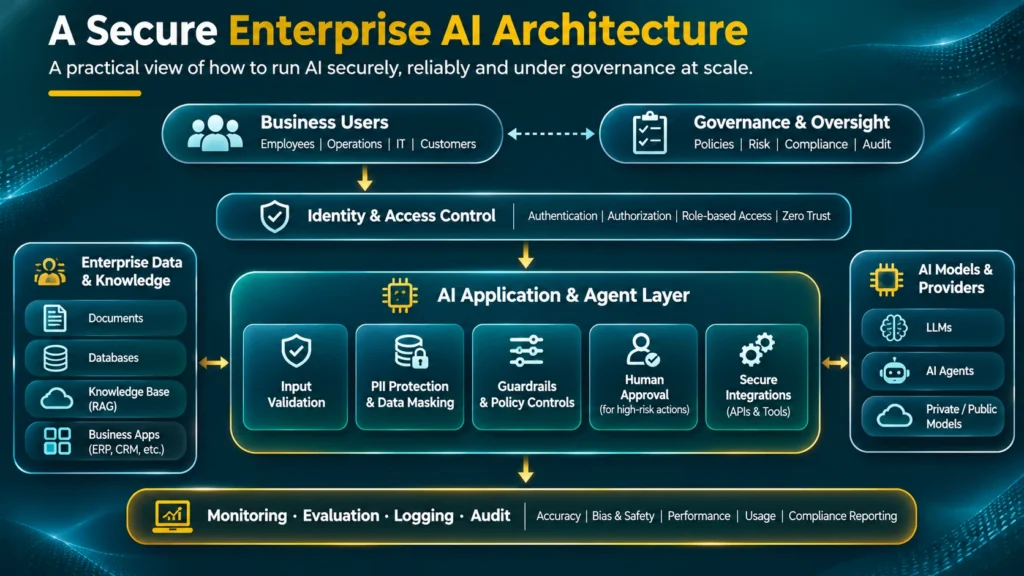
2. Personally identifiable information (PII) protection. Identify sensitive personal information in prompts, documents and datasets. Consider data minimization, masking and other protection before information reaches an AI model. AI-driven PII protection and data masking is one approach.
3. Role-based access control. Make sure AI applications respect existing user permissions. An AI assistant should never become a shortcut around enterprise access controls.
4. Data retention and ownership. Understand whether prompts, outputs, logs and uploaded information are stored, retained or used for model improvement, and set contractual and operational expectations.
5. Third-party data exposure. Evaluate how external AI providers process, store and protect your information.
For RAG (Retrieval-Augmented Generation) applications, the retrieval layer deserves particular attention. Connecting a model to an internal knowledge base does not automatically make every document safe for every user to retrieve. Well-designed RAG-powered AI assistants respect permissions at the retrieval layer.
The takeaway: Enterprise AI security starts with understanding and controlling the data that enters, moves through and leaves an AI system.
2. How do we prevent AI from doing something it shouldn’t?
The CISO’s concern: Can we control what AI applications and autonomous agents are permitted to do?
Traditional applications generally execute predefined operations. AI agents are more flexible. They can interpret requests, retrieve information, use tools, call APIs and run multi-step workflows.
Imagine an AI agent integrated into an enterprise procurement system. It can review purchase requests, look up supplier information and start approval workflows. But what stops it from accessing an unauthorized system, taking an action without approval, or following malicious instructions hidden inside retrieved content?
This is where AI application security becomes essential.
In April 2026, Gartner predicted that by 2028, 25% of enterprise generative AI applications will experience at least five minor security incidents per year, up from 9% in 2025. Gartner linked the rise to the growth of agentic applications built with tools such as the Model Context Protocol (MCP), where new attack paths and immature security practices increase exposure. (Gartner, April 9, 2026)
What should technology leaders evaluate?
1. Prompt injection protection. Assess how applications respond to malicious instructions in user inputs, documents and retrieved content.
2. Least-privilege permissions. Give AI agents access only to the tools, APIs, systems and information they need for their assigned tasks.
3. Input and output validation. Check incoming instructions, retrieved information and generated outputs before they influence important business operations.
4. Human-in-the-loop approvals. Require human review for sensitive transactions, high-impact decisions and actions with significant business consequences.
5. Monitoring and escalation. Put mechanisms in place to spot unusual activity, restrict unsafe actions and escalate incidents for investigation.
These controls matter most for agentic AI, where an application may move beyond making recommendations and begin carrying out business tasks.
The takeaway: AI autonomy should be proportional to the level of control, permissions and oversight your organization can reliably maintain.
3. How do we know the AI is reliable, accurate and safe?
The CISO’s concern: What evidence do we have that the AI system performs as expected?
An AI model can give a convincing answer without giving a correct one. That matters when AI supports financial analysis, customer support, internal knowledge retrieval, manufacturing operations or other business-critical work.
A successful demonstration does not establish production readiness. AI systems can produce inaccurate information, retrieve outdated content, return inconsistent results or behave differently after a model update. The challenge grows when several models run across different applications.
What should technology leaders evaluate?
1. Model evaluation. Set evaluation criteria before deployment, and measure accuracy, relevance, consistency and task-specific performance.
2. Hallucination management. Test how the application responds when information is missing, incomplete or contradictory. It should not present unsupported answers as established fact.
3. Bias and fairness testing. Check whether outputs introduce inappropriate bias, especially in workflows involving people or high-impact decisions.
4. Continuous monitoring. Track performance after deployment. Changes in data, user behavior, prompts and models can all affect output quality.
5. Change management and revalidation. When an underlying model, retrieval source or workflow changes, repeat the relevant evaluations instead of assuming earlier results still hold.
The NIST AI Risk Management Framework offers a useful structure through four functions: Govern, Map, Measure and Manage. Together they connect risk identification, evaluation and management with ongoing oversight.
The takeaway: Demonstrate AI reliability through repeatable evaluation and continuous monitoring, not an impressive pilot.
Planning to move an AI pilot into production?
Performix helps US businesses build secure, governed AI with PII protection, RAG-powered assistants and AI agents.
Book a 15-minute Technical Discovery Call →4. What happens if our AI vendor changes, fails or disappears?
The CIO’s concern: How dependent are we on our AI provider, and can we keep operating if that relationship changes?
This is one of the most overlooked parts of enterprise AI planning. The market is moving quickly, and providers may be acquired, retire products, change commercial terms or change access to underlying models. An organization that builds critical workflows around a single provider could face disruption if that provider changes its services.
A CIO feature published October 29, 2026 examined this risk. Experts quoted in it warned that losing an AI vendor creates challenges beyond replacing software. A company’s data and customizations may live inside the vendor’s product and could be lost if the vendor shuts down or is acquired. The article also noted that switching models is closer to a revalidation than a migration, because a new model can behave differently on the same prompts, so every workflow has to be retested.
What should technology leaders evaluate?
1. Data portability. Make sure prompts, outputs, logs, configurations and relevant data can be exported in usable formats, and test the export before you sign.
2. Vendor exit provisions. Review contracts for notice periods, data return, deletion requirements and provisions for acquisition or service discontinuation.
3. Model dependency. Know which business processes rely on specific models, APIs or proprietary services.
4. Alternative deployment options. Evaluate whether other models, providers or infrastructure arrangements could support critical workloads.
5. Migration and revalidation plans. Document how workflows will be tested if a provider or model has to be replaced.
Vendor size alone does not guarantee continuity. Look at contractual protection, technical portability and operational alternatives.
The takeaway: AI vendor selection is also a business continuity decision. Plan for provider changes before they become an emergency.
5. Can we demonstrate that our AI is governed, compliant and accountable?
The CIO and CISO’s concern: Can we show how our organization identifies, manages and monitors AI risk?
AI governance is not a policy document employees read once before using an AI tool. It is an ongoing operating discipline that involves technology, security, legal, compliance, business operations and leadership.
As AI spreads across departments, you need visibility into which systems are in use, what information they process, which decisions they influence and who is accountable for them. That matters even more when customers, auditors, regulators or partners ask for evidence of oversight.
Forrester’s research points to the same gap between policy and strategy: only 42% of AI decision-makers say governance strategy is part of their organization’s official AI and agentic AI strategy. (Forrester) Policies are multiplying, but strategic integration is still catching up. AI governance and compliance works best when it is built in from the start rather than added afterward.
What should technology leaders evaluate?
1. AI inventory. Keep visibility into AI applications, models, use cases, business owners and third-party providers.
2. Risk classification. Classify AI use cases by potential impact and risk, so governance requirements match the consequences of each application.
3. Documented accountability. Define who owns, approves, monitors and reviews each AI system.
4. Audit trails and documentation. Keep appropriate records of system changes, assessments, approvals, incidents and monitoring.
5. Regulatory and framework alignment. Evaluate the requirements that apply based on your industry, jurisdiction, AI use case and role in the AI lifecycle.
For US businesses, the regulatory picture may involve state-specific requirements, sector regulations, contractual obligations and federal requirements for certain organizations. The NIST AI RMF can provide a structured foundation for governance work, but it does not replace legal or regulatory analysis.
The takeaway: If your organization can’t explain how its AI systems are governed, it will struggle to demonstrate effective oversight.
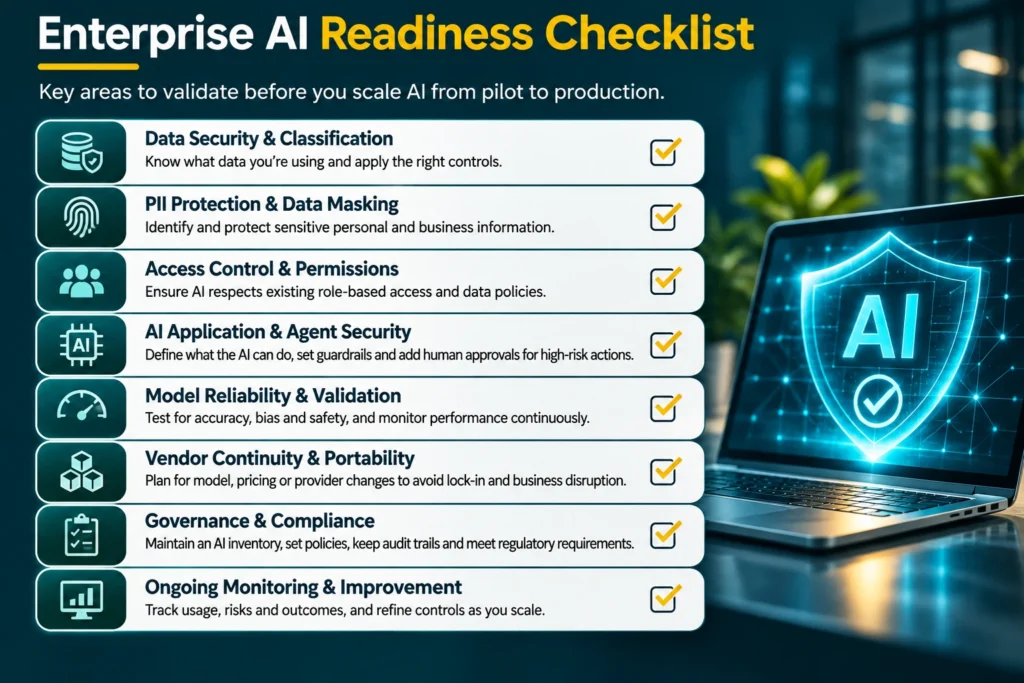
The enterprise AI readiness checklist
Before expanding AI from pilot to production, evaluate these areas:
Readiness area | Key question |
|---|---|
Data security | Do we know what data enters and leaves our AI systems? |
Privacy | Are sensitive information and PII adequately protected? |
Access control | Do AI applications and agents operate with appropriate permissions? |
Application security | Have we evaluated prompt injection and other AI-specific threats? |
Reliability | Are models and workflows tested against defined performance criteria? |
Monitoring | Can we identify unexpected behavior and security incidents? |
Vendor continuity | Can we export data and replace providers if necessary? |
Governance | Are AI systems inventoried, classified and assigned accountable owners? |
Compliance | Have we assessed the requirements that apply to our business? |
You don’t need to solve every challenge at once. But you should understand your highest-risk use cases and put appropriate controls in place before you expand.
Scaling AI is an engineering, security and governance decision
AI adoption is no longer just a technology experiment. As organizations bring AI into enterprise applications, customer experiences, internal knowledge systems and autonomous workflows, the consequences of weak security and governance grow.
The challenge for CIOs, CISOs and CTOs is not simply deciding whether to adopt AI. It is deciding how AI will be implemented, secured, monitored and managed as part of the wider technology environment.
The strongest AI strategies connect business objectives with data protection, application security, model evaluation, operational continuity and accountable governance.
The question is no longer just whether AI can work in your business. It is whether your organization is ready to operate it responsibly at scale.
Further reading
About Performix
Performix Business Services is a U.S.-based B2B technology company that helps businesses and enterprises connect AI strategy, implementation, security and governance. Its capabilities span custom AI applications, RAG-powered assistants, agentic AI, PII protection and AI governance.
Ready to put the right controls in place before you scale?
Editorial note: Statistics the original survey populations and publication dates. Framework references are informational and do not constitute legal advice