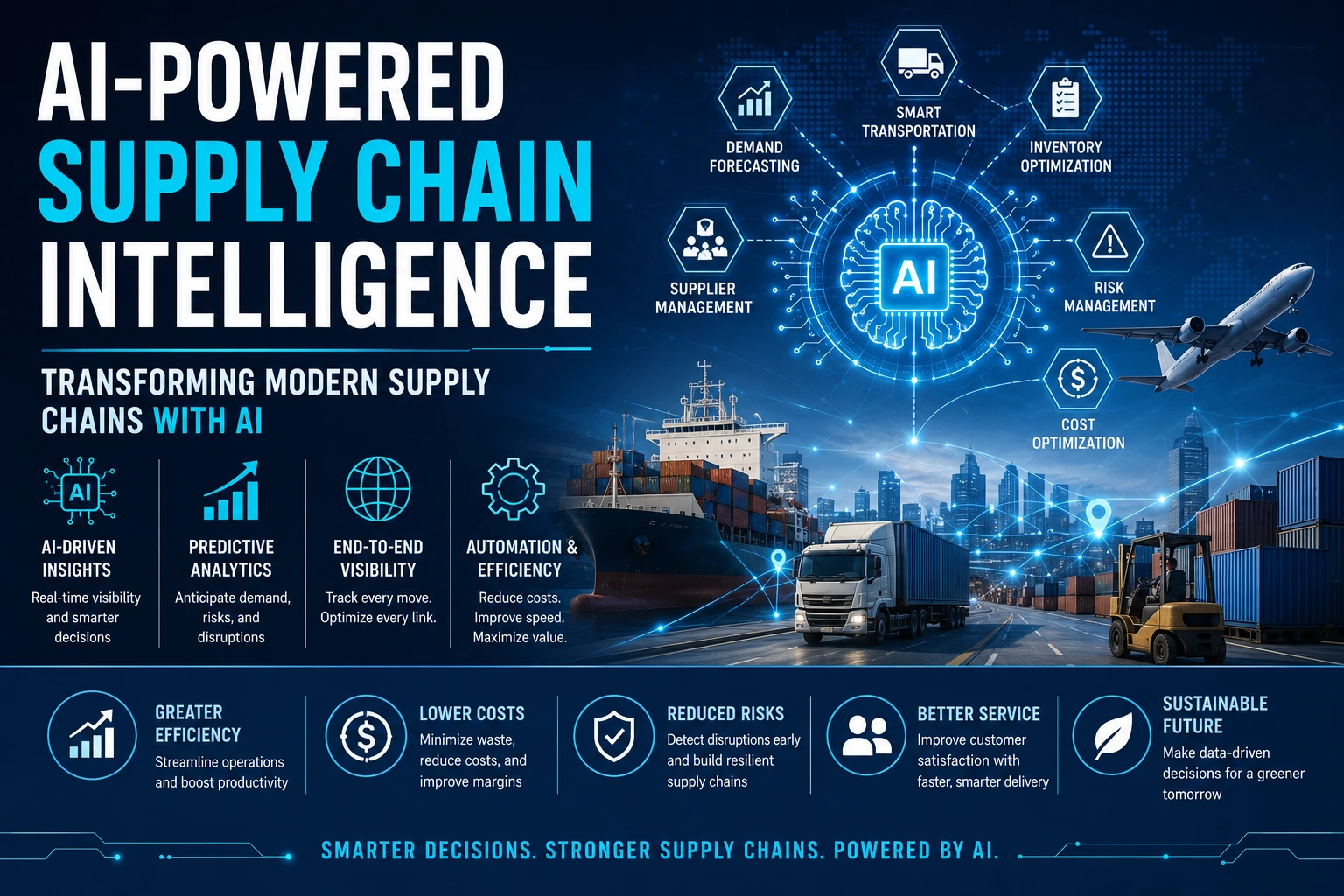
Supply chains are becoming increasingly complex. Global sourcing, changing customer demand, supplier risks, transportation disruptions, inventory pressure, and fragmented data can make traditional supply chain planning difficult.
AI-powered supply chain intelligence offers a new approach.
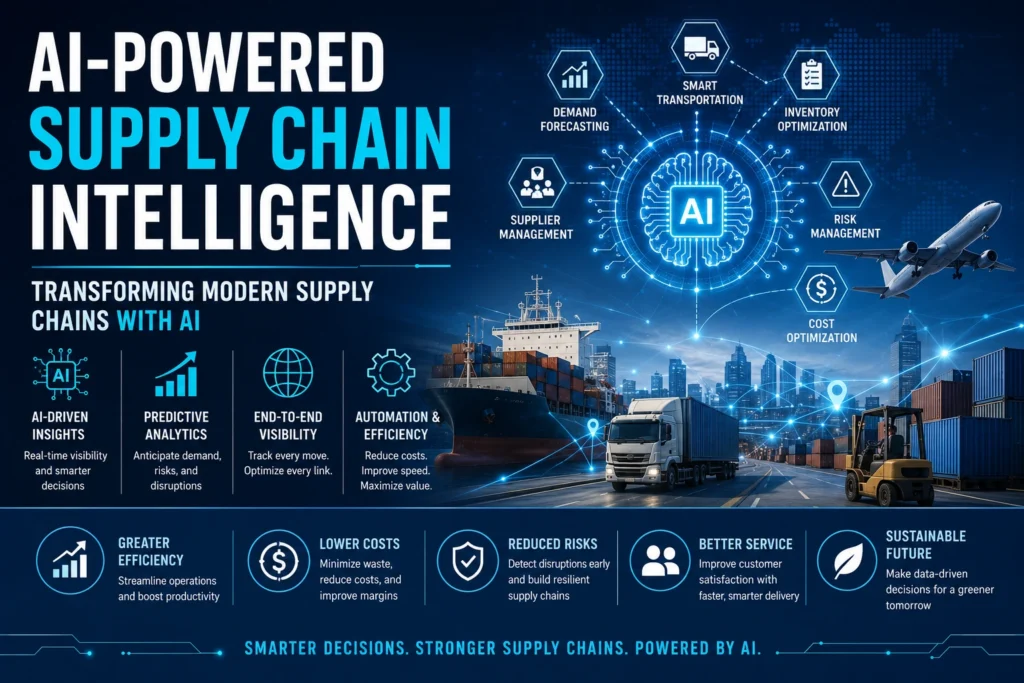
By combining artificial intelligence, machine learning, predictive analytics, automation, and real-time data, organizations can turn large volumes of supply chain information into actionable insights. Instead of relying only on historical reports, supply chain teams can use AI to identify patterns, forecast demand, detect risks, optimize inventory, evaluate suppliers, and support faster decisions.
Modern AI does not eliminate the need for supply chain professionals. Instead, it can give planners, procurement teams, logistics managers, and business leaders better information to make decisions.
What Is AI-Powered Supply Chain Intelligence?
AI-powered supply chain intelligence is the use of artificial intelligence and advanced analytics to collect, analyze, interpret, and act on data across the supply chain.
It can connect information from multiple sources, including:
- Enterprise resource planning (ERP) systems
- Warehouse management systems
- Transportation management systems
- Supplier platforms
- Procurement systems
- Customer orders
- Inventory databases
- Point-of-sale systems
- IoT devices and sensors
- Market data
- Weather and external risk data
AI can then analyze these inputs to identify trends, predict potential changes, and recommend actions.
In simple terms:
Traditional supply chain analytics explains what happened. AI-powered supply chain intelligence helps organizations understand what may happen next and what actions they could consider.
Why Is AI Important for Supply Chain Management?
Supply chain decisions are often interconnected.
A change in customer demand can affect inventory. Inventory changes can affect procurement. Procurement decisions can affect production. Production changes can affect transportation and fulfillment.
This creates a complex network of dependencies.
AI can analyze these relationships at scale and help organizations identify patterns that may be difficult to detect through manual analysis.
Research from McKinsey has highlighted applications including demand forecasting, end-to-end visibility, integrated business planning, dynamic optimization, and automation as important areas for AI-enabled supply chain transformation.
The result can be a more data-driven and responsive supply chain.
Key Applications of AI-Powered Supply Chain Intelligence
1. AI Demand Forecasting
Demand forecasting is one of the most important applications of AI in supply chain management.
Traditional forecasting often relies heavily on historical sales data. AI can incorporate additional variables and identify relationships across multiple datasets.
Depending on the industry and available data, an AI forecasting system can consider:
- Historical sales
- Seasonal trends
- Promotions
- Pricing changes
- Customer behavior
- Product lifecycle
- Regional demand
- Market conditions
- External events
The objective is not to predict the future perfectly. No forecasting system can guarantee that.
Instead, AI can help supply chain teams create more informed forecasts and respond to changes faster.
2. Intelligent Inventory Optimization
Holding too much inventory ties up capital and increases carrying costs.
Holding too little inventory can lead to stockouts, delayed deliveries, lost sales, and dissatisfied customers.
AI can help organizations balance these competing objectives.
An AI-powered inventory intelligence platform can analyze factors such as:
- Demand patterns
- Lead times
- Safety stock
- Supplier reliability
- Order frequency
- Product velocity
- Seasonal demand
- Stockout history
This can help organizations identify where inventory may be excessive, insufficient, or positioned incorrectly.
3. Supplier Risk Intelligence
Supplier disruptions can have a major impact on business operations.
AI can help organizations monitor supplier-related signals and identify potential risks earlier.
Potential inputs include:
- Supplier performance
- Delivery history
- Quality metrics
- Lead-time changes
- Geographic exposure
- Financial indicators
- Market conditions
- External events
AI can then help procurement teams prioritize suppliers that require additional attention.
The goal is not to automatically declare a supplier “high risk.” Rather, AI can act as an early-warning mechanism that helps procurement professionals investigate potential problems.
4. Procurement Intelligence
Procurement teams manage large amounts of spending, supplier information, contracts, and purchasing data.
AI can help analyze this information to identify:
- Spending patterns
- Supplier concentration
- Purchasing anomalies
- Cost trends
- Contract opportunities
- Category-level opportunities
- Potential sourcing alternatives
Generative AI can also provide natural-language interfaces that allow procurement professionals to ask questions about spending and supplier data rather than relying exclusively on predefined reports. McKinsey has identified applications of AI and generative AI across spend analysis, demand forecasting, sourcing, and supplier management.
5. Logistics and Transportation Optimization
Transportation is another area where AI can support decision-making.
AI-powered logistics intelligence can analyze:
- Shipment volumes
- Delivery routes
- Transportation costs
- Carrier performance
- Delivery windows
- Traffic conditions
- Fuel-related variables
- Warehouse locations
Organizations can use these insights to evaluate routing and transportation decisions.
AI can also help identify exceptions, allowing logistics teams to focus their attention on shipments that require intervention.
6. Warehouse Intelligence
AI can help warehouses move from reactive operations toward more predictive processes.
Potential applications include:
- Inventory location optimization
- Demand-based replenishment
- Picking optimization
- Workforce planning
- Warehouse capacity forecasting
- Anomaly detection
- Equipment monitoring
When AI is combined with warehouse data and connected systems, organizations can gain a more comprehensive view of warehouse performance.
7. Supply Chain Risk Prediction
Supply chain disruptions can originate from many sources.
Examples include:
- Supplier failures
- Transportation delays
- Geopolitical events
- Natural disasters
- Demand fluctuations
- Raw-material shortages
- Infrastructure disruptions
AI can analyze internal and external data to identify potential risk signals.
Instead of discovering a problem only after it affects operations, organizations can use predictive intelligence to create earlier warning signals.
This supports a shift from reactive supply chain management to proactive risk management.
8. AI-Powered Supply Chain Control Towers
A supply chain control tower provides a centralized view of supply chain activity.
AI can make control towers more intelligent by helping teams:
- Detect anomalies
- Prioritize exceptions
- Identify risks
- Forecast disruptions
- Analyze scenarios
- Recommend potential actions
Instead of presenting hundreds of dashboards and alerts, an AI-enabled control tower can help users focus on the events that may have the greatest operational impact.
Benefits of AI-Powered Supply Chain Intelligence
Better Decision-Making
AI can analyze large datasets and provide decision-support insights faster than manual analysis.
Improved Supply Chain Visibility
Connecting data from different systems can provide organizations with a more comprehensive view of supply chain performance.
Faster Response to Disruptions
Predictive signals can help teams identify potential problems earlier and investigate mitigation options.
More Efficient Inventory Management
AI can help organizations make more informed decisions about inventory levels, replenishment, and allocation.
Improved Procurement Insights
AI can reveal spending patterns, supplier trends, and potential sourcing opportunities.
Reduced Manual Analysis
Automation can reduce the time employees spend preparing reports, consolidating data, and performing repetitive analysis.
More Agile Planning
AI can support scenario analysis and help teams evaluate possible responses to changes in demand, supply, or logistics.
AI Supply Chain Intelligence vs. Traditional Supply Chain Analytics
Traditional analytics remains valuable, but AI expands what organizations can do with their data.
| Traditional Analytics | AI-Powered Intelligence |
|---|---|
| Primarily describes historical performance | Can support predictive analysis |
| Relies heavily on predefined reports | Can analyze complex patterns |
| Often requires manual interpretation | Can surface anomalies and recommendations |
| Periodic reporting | Can support near-real-time monitoring |
| Human-driven analysis | Human decision-making supported by AI |
| Static dashboards | More dynamic and context-aware insights |
This does not mean traditional analytics should be replaced.
The strongest supply chain strategies often combine reliable reporting, business intelligence, advanced analytics, and AI.
How AI Creates a More Intelligent Supply Chain
AI-powered supply chain intelligence typically works across several layers.
Data Layer
Collect data from ERP, WMS, TMS, CRM, procurement, supplier, IoT, and external sources.
Integration Layer
Connect information across systems so data can be analyzed consistently.
Intelligence Layer
Use machine learning, predictive analytics, optimization algorithms, or generative AI to identify patterns and generate insights.
Decision Layer
Present insights, alerts, forecasts, or recommendations to supply chain professionals.
Action Layer
Allow authorized users or connected systems to execute appropriate decisions or workflows.
This architecture creates a continuous cycle:
Data → Intelligence → Insight → Decision → Action → Feedback
The feedback loop is important because supply chain conditions continuously change.
Generative AI in Supply Chain Management
Generative AI is adding another layer to supply chain intelligence.
Traditional AI might predict demand or detect anomalies.
Generative AI can help users interact with supply chain information using natural language.
For example, a supply chain manager could ask:
“Which suppliers experienced the largest increase in delivery delays this quarter?”
Or:
“What products have the highest stockout risk over the next four weeks?”
Or:
“What could happen to inventory requirements if demand increases by 15%?”
The system can then retrieve relevant information and present an understandable response.
However, generative AI should not be treated as an unquestionable source of truth. Organizations should design systems around trusted data, appropriate access controls, validation, monitoring, and human review.
McKinsey’s 2025 discussion of generative AI in supply chains similarly emphasizes that the technology can support efficiency and decision-making but requires appropriate technology, data, and talent foundations.
Digital Twins and AI-Powered Supply Chains
Digital twins can provide another powerful capability.
A digital twin represents a physical or operational system digitally, allowing organizations to model scenarios.
When combined with AI, organizations can explore questions such as:
- What happens if demand increases?
- What happens if a supplier misses deliveries?
- How would a warehouse closure affect fulfillment?
- What happens if transportation capacity decreases?
- Where should inventory be positioned?
AI can help analyze potential scenarios and identify possible responses.
This can move supply chain planning from simple forecasting toward scenario-based decision intelligence.
Challenges of Implementing AI in Supply Chains
AI is not a shortcut around poor processes or poor data.
Organizations may encounter several challenges.
Poor Data Quality
AI systems depend on the quality of the data used to train, operate, and evaluate them.
Inconsistent product codes, missing supplier information, outdated inventory data, or disconnected systems can reduce the usefulness of AI insights.
Fragmented Technology
Organizations often operate multiple ERP, WMS, TMS, procurement, and analytics platforms.
Connecting these systems can require significant integration work.
Lack of AI Skills
Organizations may need expertise in:
- Data engineering
- Machine learning
- Cloud architecture
- AI governance
- Supply chain operations
- Cybersecurity
- Business analysis
Change Management
Employees may resist AI if they do not understand how it affects their responsibilities.
Successful implementation requires training, communication, and clear ownership.
Model Accuracy and Drift
A model that performs well today may perform differently when market conditions, customer behavior, supplier networks, or business processes change.
Continuous monitoring is therefore essential.
AI Governance for Supply Chain Intelligence
Responsible AI governance is particularly important because supply chain AI may influence purchasing, inventory, supplier selection, logistics, and financial decisions.
Organizations should establish policies covering:
- Data governance
- Security
- Access control
- Model validation
- Human oversight
- Vendor management
- AI performance monitoring
- Incident management
- Auditability
- Model updates
The NIST AI Risk Management Framework provides a voluntary framework built around four functions: Govern, Map, Measure, and Manage. NIST also emphasizes lifecycle-based risk management and consideration of risks associated with third-party software, hardware, and data.
For supply chain AI, this is especially relevant because organizations frequently depend on external vendors, cloud platforms, data providers, and third-party AI components.
How to Implement AI-Powered Supply Chain Intelligence
A successful AI implementation should start with a business problem rather than an AI tool.
Step 1: Identify the Business Problem
Start with a measurable challenge.
Examples:
- Forecasting inaccuracies
- Excess inventory
- Stockouts
- Supplier delays
- Transportation inefficiencies
- Manual reporting
- Poor supply chain visibility
Step 2: Define Success Metrics
Establish measurable KPIs before implementing the technology.
Possible metrics include:
- Forecast accuracy
- Inventory turnover
- Stockout rate
- Order fulfillment rate
- Supplier on-time delivery
- Transportation cost
- Planning cycle time
- Working capital
- Exception resolution time
Step 3: Assess Data Readiness
Review the availability, quality, structure, and accessibility of supply chain data.
Step 4: Build the Integration Foundation
Connect the relevant enterprise systems and establish reliable data pipelines.
Step 5: Select the Appropriate AI Approach
Not every problem requires generative AI.
Depending on the use case, organizations may need:
- Machine learning
- Predictive analytics
- Optimization
- Computer vision
- Generative AI
- Anomaly detection
- Digital twins
Step 6: Start With a Pilot
Choose a focused use case where results can be measured.
A pilot allows the organization to validate:
- Data quality
- Model performance
- User adoption
- Workflow integration
- Business value
Step 7: Integrate Human Decision-Making
AI should provide appropriate recommendations and insights while allowing authorized professionals to review important decisions.
Step 8: Monitor and Improve
AI systems should be continuously evaluated as supply chain conditions evolve.
How to Measure AI Supply Chain ROI
AI investments should be connected to measurable business outcomes.
A useful framework includes:
| Area | Example KPI |
|---|---|
| Forecasting | Forecast accuracy |
| Inventory | Inventory turnover |
| Availability | Stockout rate |
| Procurement | Cost savings/opportunity identification |
| Suppliers | On-time delivery |
| Logistics | Transportation cost per shipment |
| Operations | Planning cycle time |
| Productivity | Hours saved |
| Service | Order fulfillment rate |
| Risk | Time to identify supply disruptions |
The right metrics depend on the organization’s industry, supply chain structure, and AI use case.
The Future of AI-Powered Supply Chain Intelligence
The future of supply chain management is likely to be increasingly predictive, connected, and automated.
AI agents, generative AI, digital twins, IoT, predictive analytics, and intelligent automation can work together to create supply chain systems that continuously monitor conditions and support decision-making.
However, the future will not be defined by technology alone.
Organizations will need:
High-quality data + integrated systems + strong AI models + supply chain expertise + responsible governance + human oversight.
The competitive advantage will come from turning these capabilities into practical business outcomes.
How Performix Can Help Businesses Build AI-Powered Supply Chain Solutions
Implementing AI across a supply chain requires more than deploying an algorithm.
Organizations need technology architecture, data integration, analytics, application development, automation, security, and a clear understanding of the business problem.
Performix can help businesses explore and develop AI-enabled technology solutions designed around their operational objectives.
A practical AI transformation can begin with a focused use case—such as demand forecasting, inventory intelligence, procurement analytics, supplier risk monitoring, or logistics optimization—and then expand as the organization develops its data and AI capabilities.
The objective should be clear: use AI to turn supply chain data into timely, actionable intelligence that helps people make better decisions.
Frequently Asked Questions About AI-Powered Supply Chain Intelligence
What is AI-powered supply chain intelligence?
AI-powered supply chain intelligence uses artificial intelligence, machine learning, predictive analytics, and related technologies to analyze supply chain data, identify patterns, predict potential events, and support operational decision-making.
How does AI improve supply chain management?
AI can support demand forecasting, inventory optimization, supplier risk analysis, procurement, logistics, warehouse operations, anomaly detection, and supply chain planning.
Can AI predict supply chain disruptions?
AI can identify patterns and signals associated with potential disruptions, but it cannot guarantee that a disruption will be predicted. Its effectiveness depends on data quality, model design, external information, and changing real-world conditions.
How does AI help with inventory management?
AI can analyze demand, lead times, order patterns, supplier performance, and inventory history to support replenishment, allocation, and safety-stock decisions.
What is generative AI in supply chain management?
Generative AI can provide natural-language interfaces for supply chain information, summarize data, assist with analysis, generate reports, and support planners in exploring supply chain scenarios.
Does AI replace supply chain managers?
AI is better viewed as a decision-support capability than a complete replacement for supply chain professionals. Human expertise remains important for interpreting context, managing exceptions, making strategic decisions, and handling situations that require judgment.
What data is needed for supply chain AI?
Depending on the use case, useful data can include sales history, inventory records, purchase orders, supplier performance, transportation information, warehouse data, customer orders, production information, and relevant external data.
How should a company start implementing supply chain AI?
Start with a specific business problem, define measurable KPIs, assess data readiness, select the appropriate AI technology, run a controlled pilot, measure the results, and scale successful solutions.
Is AI-powered supply chain intelligence suitable for small and mid-sized businesses?
Yes. Organizations do not necessarily need to implement AI across their entire supply chain at once. A focused use case with accessible data and measurable outcomes can be a practical starting point.
Conclusion
AI-powered supply chain intelligence is changing how organizations understand, plan, and manage complex supply networks.
From demand forecasting and inventory optimization to procurement, supplier risk, logistics, warehouse management, and intelligent control towers, AI can help businesses turn fragmented supply chain data into actionable insights.
But successful AI adoption is not simply about choosing the most advanced model.
It requires reliable data, connected systems, measurable objectives, appropriate technology, responsible governance, and people who understand how to turn AI-generated insights into business decisions.
For organizations looking to build a more resilient and intelligent supply chain, the right approach is to start with a real operational challenge, prove measurable value, and scale AI capabilities strategically.
The future of supply chain management is not just connected. It is increasingly intelligent, predictive, and decision-driven.