Healthcare leaders are drowning in data but starving for insight. CIOs, CISOs, Compliance Officers, and Digital Transformation leaders face fragmented systems, rising HIPAA risk, and growing expectations for AI‑driven decision-making. Everyone agrees analytics is the answer—but the real question is: how do you choose the right mix of consulting expertise and SaaS platform that actually delivers outcomes, not just dashboards?
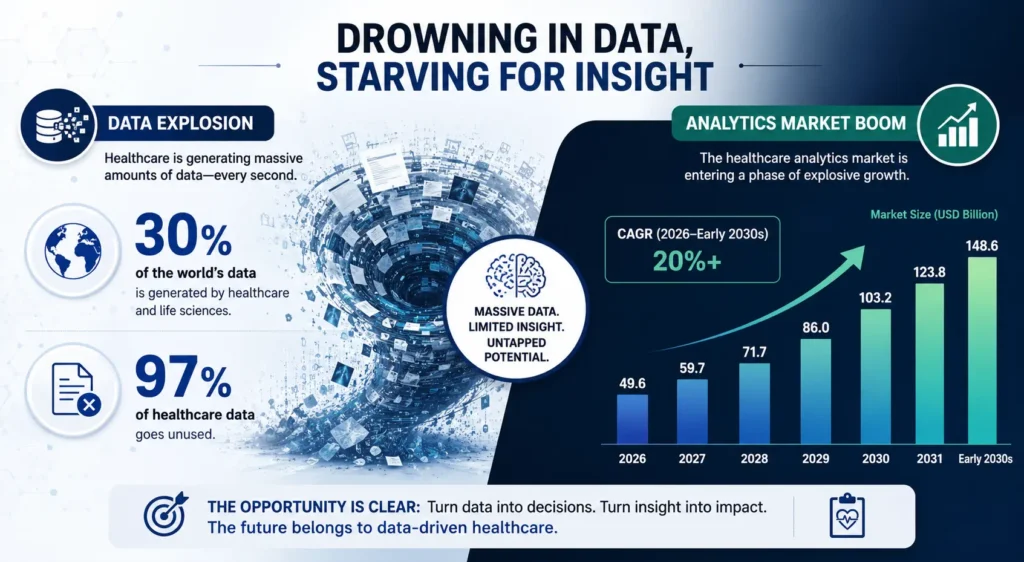
Recent market analyses estimate that the global healthcare analytics market will expand rapidly from the tens of billions of dollars in 2026 to well over 190–260 billion by the early 2030s, driven by value‑based care, digitization, and AI adoption. Yet, 2026 statistics show that healthcare organizations generate around 30% of the world’s data while roughly 97% of hospital data still goes unused in decision-making. This buyer’s guide is designed to help healthcare decision‑makers close that gap with a practical evaluation framework and checklist for analytics consulting and SaaS solutions.[coherentmarketinsights]
The real problem: dashboards without decisions
Most healthcare organizations already have reporting tools. The problem is rarely “no dashboards”; it’s:
- Data scattered across EHRs, billing systems, labs, imaging, wearables, and third‑party apps.
- Manual reporting for audits and compliance, consuming analyst time but still missing key risks.
- Multiple vendors with overlapping functionality and no unified governance.
- Difficulty using AI safely on PHI/PII without introducing compliance or security risk.
Many hospitals and health systems sit on an enormous data asset they barely use, even as spending on analytics and big data tools accelerates across the U.S. and globally. When you go to market for “analytics,” you’re not just buying charts—you’re buying decision systems: strategy, technology, and processes that convert raw data into secure, actionable outcomes.[worldmetrics]
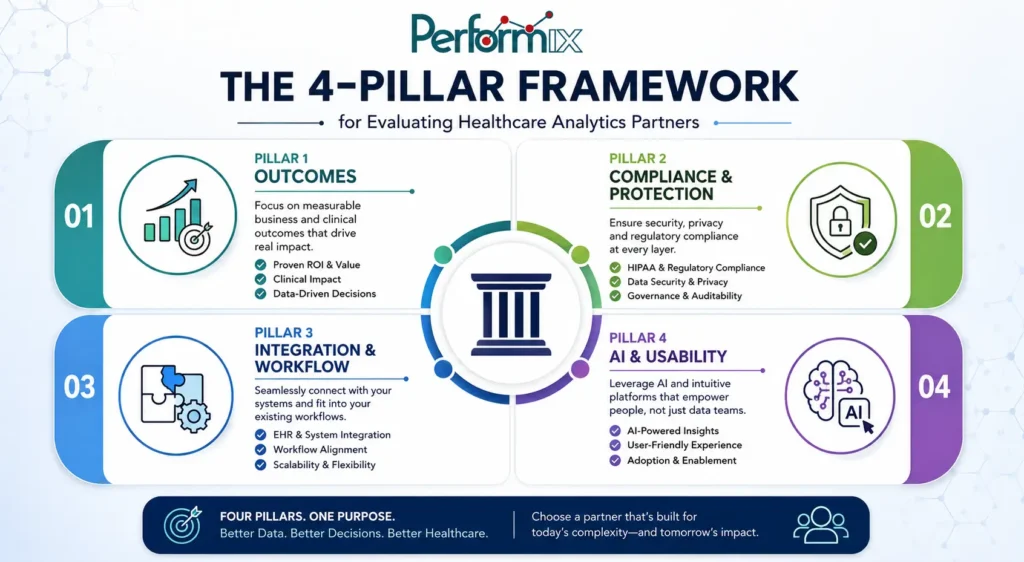
The 4‑Pillar Framework for Evaluating Healthcare Analytics Partners
To simplify complex options, use this 4‑pillar framework when evaluating vendors:
- Clinical and operational outcomes
- Compliance and data protection
- Integration and workflow fit
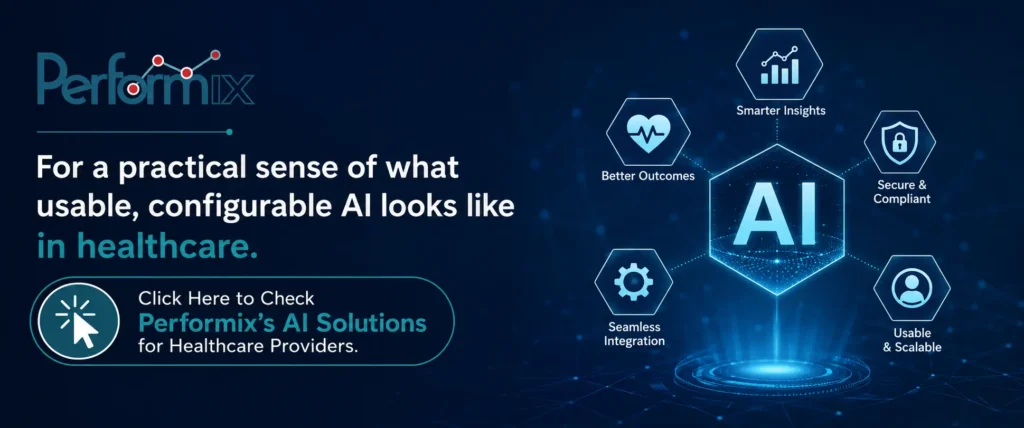
- AI capabilities and usability
Strong partners and platforms perform well across all four, not just one.
Pillar 1: Clinical and operational outcomes
The first question isn’t “what features do you have?” but “what outcomes can you deliver?”
Look for vendors who can connect their solution to:
- Reduced readmissions, better care quality, or improved patient safety.
- More efficient staffing, resource utilization, and throughput.
- Revenue integrity, claim accuracy, and reduced denials.
Recent analyses of clinical analytics highlight that decision‑support and workflow optimization are key drivers behind market growth, with providers leveraging analytics to anticipate risks and manage costs more proactively. Ask for concrete examples: “Show us a workflow where your platform helped a hospital or network identify a risk, act on it, and measure impact.” The best vendors will talk fluently about real‑world use cases, not just abstract metrics.[globenewswire]
Pillar 2: Compliance and data protection
In healthcare, analytics without rock‑solid data protection is a liability.
Key considerations:
- How does the platform detect, classify, and protect PHI/PII across documents, databases, apps, and workflows?
- What access controls, encryption standards, logging, and audit trails are in place?
- How are compliance workflows supported—e.g., automated alerts, reporting, or risk scoring?
With major AI platforms increasingly touching healthcare data, 2026 commentary emphasizes HIPAA‑aligned AI governance as a core procurement concern for CIOs and CISOs. Modern solutions embed AI into data protection: automatically scanning for sensitive data, flagging exposure risks, and simplifying HIPAA‑aligned practices. This allows you to unlock more powerful analytics without sacrificing compliance or trust.[ehiehr]
Pillar 3: Integration and workflow fit
A sophisticated platform that doesn’t fit into your existing ecosystem will never be fully adopted.
Evaluate:
- Connectivity to EHRs, practice management systems, billing, and clinical systems.
- Support for common healthcare standards and integration patterns.
- Ability to work with your current identity, security, and infrastructure stack.
Global market reports highlight that the spread of EHRs and interoperability initiatives is a major driver of analytics adoption, especially in North America where healthcare analytics already accounts for a substantial share of digital health spending. The goal is not a massive rip‑and‑replace project. The right partner helps you consolidate and elevate your data while respecting the reality of your current systems and workflows.[coherentmarketinsights]
Pillar 4: AI capabilities and usability
Analytics in 2026 is increasingly AI‑driven, but AI only helps if it is usable by real teams.
Questions to ask:
- Does the platform merely visualize data, or does it use AI to spot patterns, anomalies, and risks across large datasets?
- Can you configure AI agents or workflows that respond to events—like unusually high access to sensitive records or performance changes in a department?
- Is there a no‑code or low‑code layer so analysts, compliance teams, and operations leaders can build and adapt workflows without heavy development work?
Recent 2026 trend articles point to “agentic AI,” predictive modeling, and AI governance as priority capabilities for enterprise healthcare analytics platforms. Usability is crucial: a solution only used by a small technical group will never unlock the full value of AI for your organization.[technavio]
From framework to action: a vendor checklist you can use tomorrow
When you evaluate healthcare analytics consulting firms and SaaS platforms, use this practical checklist in your RFPs, calls, and demos.
Outcomes
- Which clinical, operational, and financial use cases have you implemented for healthcare clients?
- Can you share a before/after story where your platform changed a measurable KPI?
Compliance and data protection
- How do you detect and protect PHI/PII across systems?
- What logging, audit, and reporting features are available for compliance teams?
- How do you support HIPAA‑aligned practices in day‑to‑day workflows?
Integration and workflow
- Which healthcare systems and standards do you integrate with out‑of‑the‑box?
- How do you handle data from legacy systems or custom applications?
- What does a typical implementation timeline look like for a mid‑size hospital or network?
AI and usability
- What AI capabilities exist beyond basic reporting?
- Can non‑technical users configure dashboards, workflows, and alerts?
- How do you support training and adoption across clinical, operational, and compliance teams?
Why modern platforms blend consulting + SaaS
Historically, healthcare organizations hired consulting firms to design data strategies and then separately purchased analytics tools, often resulting in beautifully designed roadmaps but limited execution. Modern partners blend:
- Strategic consulting to understand your unique environment, use cases, and constraints.
- A robust SaaS platform to turn strategies into repeatable, automated workflows.
- Ongoing support to optimize and expand use cases as your organization evolves.
Investor and market data reinforce this model. Healthcare analytics and SaaS segments are projected to grow at strong double‑digit CAGRs through the early 2030s, reflecting long‑term demand for data‑driven, outcome‑focused solutions. Valuation reports for Q1 2026 show healthcare SaaS platforms commanding a notable premium over general B2B SaaS, especially in areas like clinical decision support and revenue cycle automation where analytics, AI, and compliance intersect. This suggests buyers and investors alike see integrated, AI‑ready platforms as the future of healthcare operations.[coherentmarketinsights]
What a platform like Performix brings to this picture
When you apply the 4‑pillar framework to a modern, AI‑driven data platform, you start to see the difference between generic BI tools and solutions built for healthcare realities.
A platform in this category typically offers:
- Smart data management to unify and govern data across systems, keeping it secure while making it usable.
- AI‑driven analytics and agents that can detect patterns, highlight anomalies, and automate responses—whether that means flagging a compliance risk or surfacing operational inefficiencies.
- Deep healthcare integration and customization, allowing you to connect to existing workflows and build bespoke applications where needed.
- No‑code/low‑code interfaces so teams can build and adjust analytics experiences without constant reliance on developers.
For healthcare CIOs and CISOs, this isn’t just about “getting a new analytics tool.” It’s about building an intelligent data backbone that supports outcomes, compliance, and innovation simultaneously—exactly the space where platforms like Performix aim to operate.[g-co]
Conclusion: turn unused data into secure, AI‑driven decisions
Healthcare is entering a phase where data, AI, and compliance are inseparable. The market is growing fast, but the real competitive advantage goes to organizations that can turn their vast, underused data into secure, repeatable decision systems that improve care, reduce risk, and strengthen financial performance. Choosing the right partner is no longer about picking a dashboard tool; it’s about selecting consulting and SaaS capabilities that align with the four pillars of outcomes, protection, integration, and usable AI.[coherentmarketinsights]
By using the framework and checklist in this guide, healthcare leaders can move beyond generic promises and systematically evaluate which vendors are truly built for the realities of modern healthcare. For platforms like Performix, the goal is to sit at the intersection of AI, data protection, and domain‑specific workflows—helping organizations transform data from a burden into a strategic asset.[g-co]