
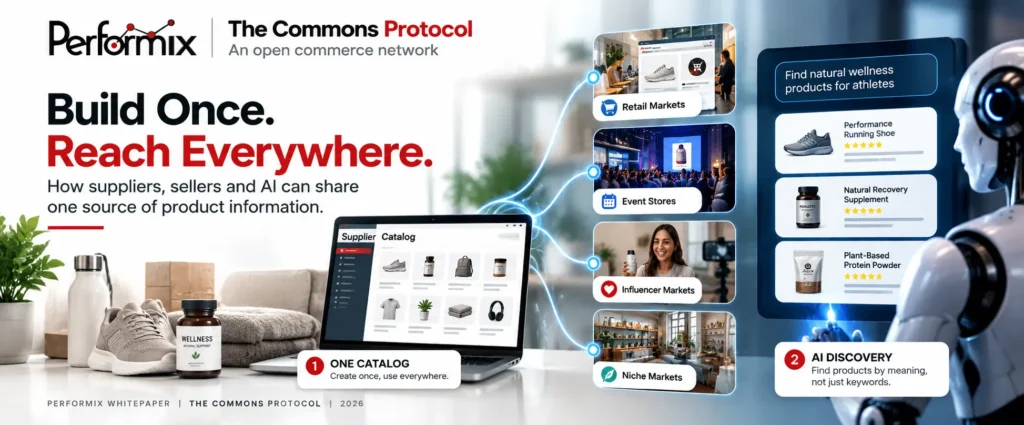
Build Once. Reach Everywhere.
How suppliers, sellers, and AI can share one source of product information
Executive summary
Online shopping was built around individual stores. Increasingly, people find products by asking AI assistants instead. That shift exposes a long-standing problem: every business that sells a product re-enters the same product information for every place it is sold. The result is duplicated work, inconsistent data, and product information that AI systems struggle to read.
The Commons Protocol, built by Performix, is designed to fix that. It is an open commerce network where:
- Suppliers keep one catalog of their products and use it everywhere.
- Merchants (the businesses that sell to shoppers) build stores from products already in the network, instead of building catalogs from scratch.
- AI systems find products based on what a shopper means, not just the exact words they type.
This paper explains the problem, how The Commons works, which parts are available today and which are still in development, and the decisions behind the design. It ends with questions any leadership team can use to spot similar duplicated effort in its own business.
1. The problem: the same information, rebuilt everywhere
Products are now sold through many channels: online stores, marketplaces, specialty retailers, events, influencer storefronts and new AI shopping tools. But the information about those products sits in separate systems that don’t talk to each other. Each group feels the pain differently.
Suppliers re-create their catalogs for every channel. Product descriptions, images, specifications, brand details and collections are copied again and again. This takes time and creates errors and inconsistencies.
Merchants struggle to find products to sell. A business that wants to open a store for a specific audience often has to spend a lot of effort gathering and entering product information before it has anything worth selling.
AI systems have to make sense of thousands of websites that all present information differently. Finding a web page is easy. Working out what products exist, who supplies them, where they can be bought, and whether they fit what a shopper is asking for is hard. As more people rely on AI-generated answers instead of lists of search results, this gap matters more.
These are three symptoms of one underlying problem: everyone keeps rebuilding information and connections that could be shared.
2. The approach: one shared network, clear roles
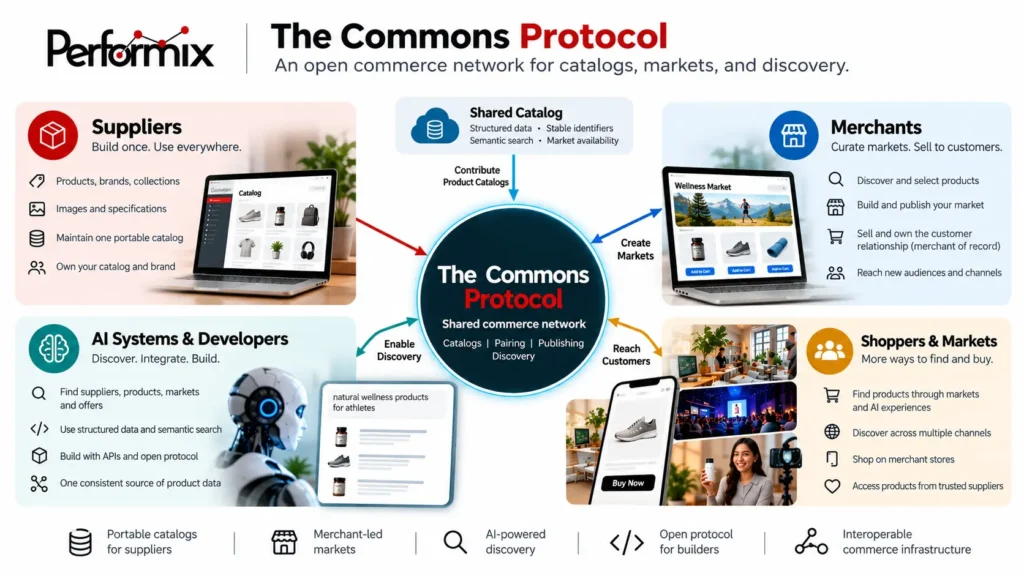
The Commons is not a traditional marketplace that sits in the middle and owns the sale. It is a shared network that gives each participant a clear role and connects them.
Suppliers
- What they do: Create and maintain one catalog (products, brands, collections, images and specifications) that can be used in any market.
- What they keep: Ownership of their catalog and their brand identity.
Merchants
- What they do: Choose suitable products from the network, organize them into their own store (which The Commons calls a “market”), publish it and sell.
- What they keep: The sale and the customer relationship. The merchant remains the “merchant of record,” meaning the business responsible for the sale.
The Commons
- What it does: Provides the shared catalog, connects suppliers with merchants, supports publishing, and makes products findable by AI.
- What it does not do: Run the store. It connects products to markets; it never becomes the seller.
AI systems and developers
- What they do: Find suppliers, products, stores and offers through organized data and meaning-based search.
- What they gain: One consistent, reliable source of product data to build on, instead of copying (“scraping”) information from thousands of websites.
The model rests on three ideas:
- Build once: suppliers maintain a single catalog.
- Reach many markets: the same catalog can feed retail stores, event stores, influencer shops and specialty markets.
- Be findable by AI: product information is organized so machines can understand it.
Learn more for suppliers, merchants, and AI builders.
3. How it works: from catalog to sale
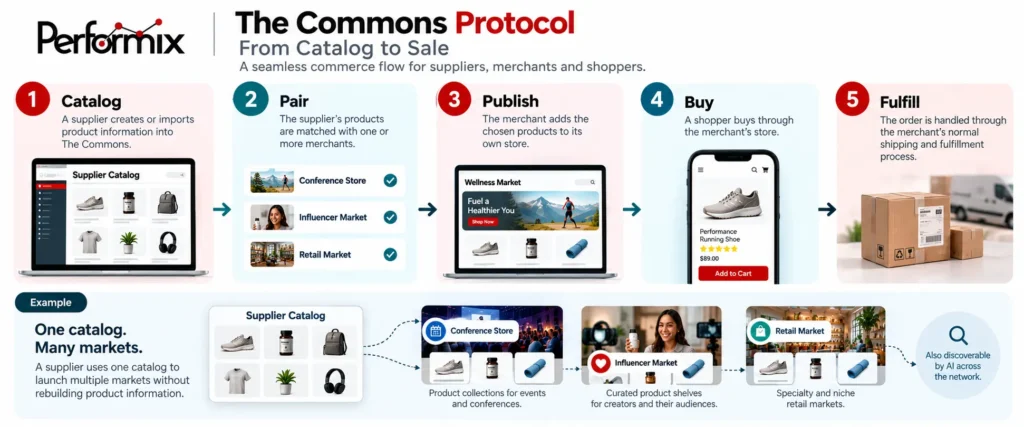
A sale moves through five steps:
Catalog → Pair → Publish → Buy → Fulfill
- Catalog: A supplier creates or imports its product information into The Commons.
- Pair: The supplier’s products are matched with one or more merchants that want to sell them.
- Publish: The merchant adds the chosen products to its own store.
- Buy: A shopper buys through that merchant’s store.
- Fulfill: The order is handled through that store’s normal shipping and fulfillment process.
Example: A supplier uses one catalog to launch a store at a conference, a product shelf for an influencer, and a listing in a specialty retail market. Nothing is rebuilt for each one. The supplier still owns the catalog, and AI systems can find the same products in all three places.
The goal of the first version is to prove that this full cycle works from start to finish. Sales volumes and business results will be reported only once they have been verified.
4. AI discovery: product information machines can understand
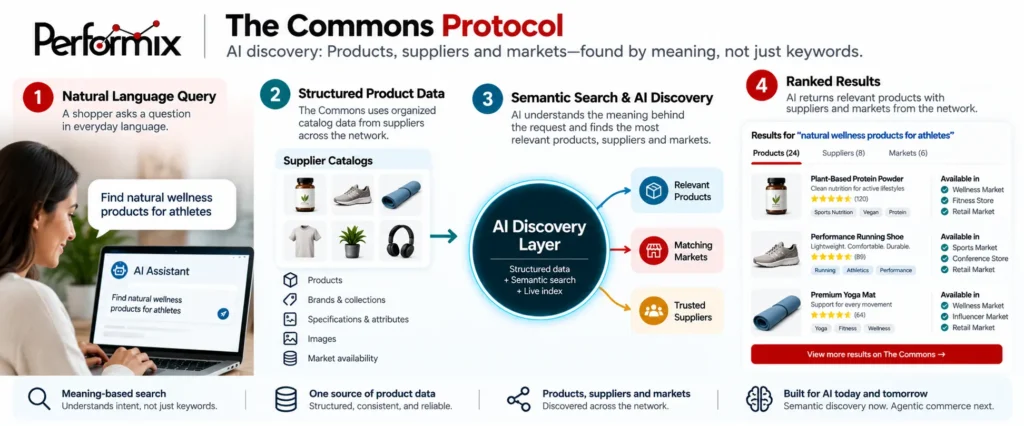
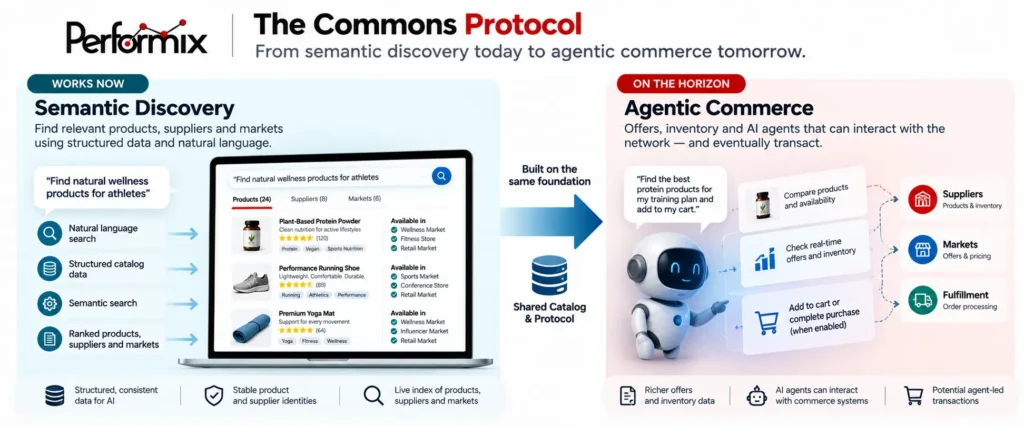
Traditional search matches keywords against whatever each website happens to publish. Meaning-based search (often called “semantic search”) tries to understand what the person actually wants.
For example, a shopper might ask: “Find natural wellness products suitable for athletes.” Instead of looking only for those exact words, The Commons interprets the request and returns a ranked list of matching products, suppliers and stores from its live product index.
Four things make this possible:
- Organized product data: every product is described using the same set of defined fields.
- Consistent IDs: each supplier, product and store has a stable identifier, so systems always know which one they are looking at.
- Store availability: the network knows which stores offer which products.
- Meaning-based search: results are based on intent, not exact wording.
Put simply, The Commons gives AI assistants one organized, reliable source of product data, instead of making them search, copy, interpret and reconcile thousands of inconsistent websites.
Try it yourself: ask The Commons a question at thecommonsprotocol.com/explore.
An important caveat: being in The Commons does not guarantee that a product will appear in every AI assistant’s answers. That depends on which products are available, how complete and accurate the catalog is, how the data is indexed, which AI tools are connected, and how those tools work.
5. What’s available now, and what’s next
Today (available now)
- Meaning-based search across the live product index
- Portable supplier catalogs that can be used in any market
- Tools for matching products with merchants and publishing them
Next (in development)
- Richer shopping details: current offers, inventory levels, and which stores carry each product
Longer term (future direction, not yet built)
- AI agents that can complete purchases on a shopper’s behalf, sometimes called “agentic commerce,” using the shared catalog and store network. This will depend on connections with other systems and on appropriate safeguards.
We would rather be accurate than impressive. AI agents that shop for people may be where this leads, but they need a solid foundation first: clear product identities, accurate catalogs, known relationships between suppliers and stores, and search tools that machines can use. That foundation is what we are building now. The network is at an early stage, and it will become more useful as more suppliers and merchants join and as catalog quality improves.
6. Six design decisions behind The Commons
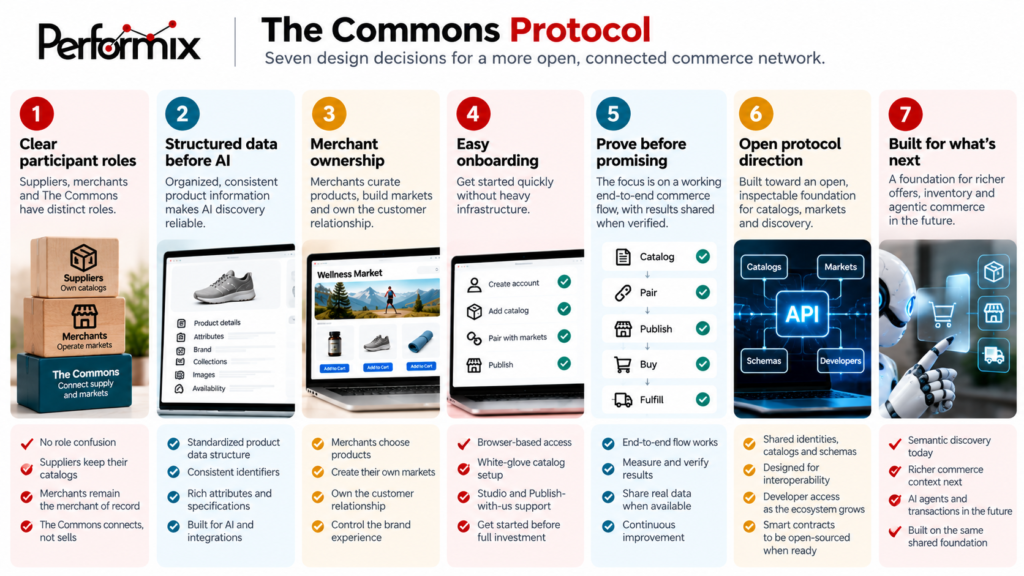
These principles shaped the product. Most apply well beyond commerce.
- Give everyone a clear role. Suppliers own catalogs, merchants run stores, and the network connects them. Clear roles make it easier to manage accountability, build trust and grow.
- Organize the data before adding AI. Meaning-based search works only because the underlying data is structured and consistently labeled. AI on top of messy data produces messy answers.
- Keep the seller in charge of the sale. Merchants sell and own the customer relationship. The network supplies products; it does not take over the store.
- Make it easy to start. Participants can begin by pairing with products already in the network, work entirely in a web browser, and get hands-on help setting up their catalog, with no need to build a marketplace from scratch. The tools merchants use to build and publish their market are free until activation.
- Prove it works before promising more. Meaning-based search is available today. AI agents that complete purchases are a future direction, and we label them that way.
- Build it to be open. The Commons is designed as an open standard that anyone can build on. Its shared IDs, catalogs, relationships, data formats, stores and search are designed to be accessed through an open API, with developer documentation at thecommonsprotocol.com/developers. We plan to publish the source code as each part is ready.
7. What this means for your business
Even if you don’t run a commerce network, the same pattern probably exists somewhere in your organization. Ask:
- Where do different teams or channels re-create the same information?
- Could an AI system understand your data today, or would it have to guess?
- Do your systems and partners connect through shared standards, or through one-off custom work?
- Are roles and responsibilities clear before you scale?
8. Next steps
- See it in action: Search the network, browse suppliers and stores, and view real catalog entries at thecommonsprotocol.com/explore.
- Join as a supplier or merchant: Book a guided setup at thecommonsprotocol.com/get-started.
- Build on it: Explore the developer resources at thecommonsprotocol.com/developers.
This paper describes product capabilities as of publication. Items marked “in development” or “future direction” are plans, not commitments.
Continue the conversation
Have a challenge to solve? Let's talk.
Questions about this whitepaper, a potential collaboration, or a technology initiative? Connect with the Performix team to explore the right next step for your organization.
Questions or partnerships?
Contact the Performix team to discuss your questions, collaboration opportunities, or business requirements.
Book a Free Discovery Call ↗About Performix
Performix Business Services, LLC helps organizations—from startups to large enterprises—with AI, data, integration, and custom software, guided by one principle: business problems first.
Performix Business Services, LLC · Your Digital Transformation Partner