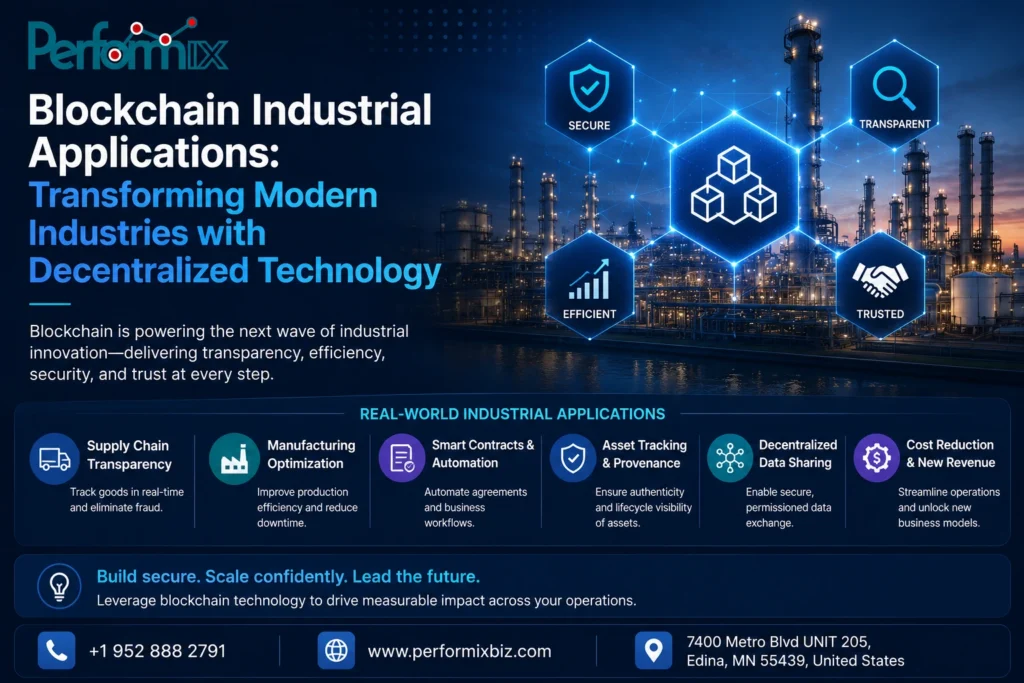
Blockchain technology has evolved far beyond cryptocurrency. Today, businesses across manufacturing, healthcare, logistics, finance, energy, retail, and supply chain management are adopting blockchain to improve security, transparency, and operational efficiency.
As industries embrace digital transformation, blockchain industrial applications have become essential for organizations looking to reduce costs, automate business processes, and build trust among stakeholders.
This guide explores how blockchain is transforming industries, the benefits it offers, real-world applications, and why businesses should invest in blockchain development.
What Are Blockchain Industrial Applications?
Blockchain industrial applications refer to the use of blockchain technology to solve business challenges across different industries. Instead of relying on centralized systems, blockchain creates a decentralized, secure, and immutable ledger where every transaction is recorded transparently.
Industrial blockchain solutions help organizations:
- Improve operational efficiency
- Reduce fraud
- Increase transparency
- Secure business data
- Automate workflows
- Enhance regulatory compliance
- Improve customer trust
Unlike traditional databases, blockchain ensures that once data is recorded, it cannot be altered without network consensus.
Why Industries Are Adopting Blockchain
Organizations worldwide are investing in blockchain because it addresses several long-standing business challenges.
Improved Data Security
Blockchain uses advanced cryptographic techniques that make data highly resistant to tampering and unauthorized access.
Complete Transparency
Every transaction is recorded and can be verified by authorized participants, improving accountability across business operations.
Reduced Operational Costs
Blockchain eliminates intermediaries and automates transactions through smart contracts, reducing administrative expenses.
Faster Business Processes
Digital verification and automated workflows speed up approvals, payments, and document management.
Better Traceability
Businesses can monitor products, assets, and transactions throughout their lifecycle.
Top Blockchain Industrial Applications
1. Supply Chain Management
Supply chains involve multiple stakeholders, making transparency a major challenge.
Blockchain enables businesses to:
- Track products in real time
- Verify product authenticity
- Reduce counterfeit goods
- Improve inventory management
- Increase supplier accountability
Example:
Food manufacturers can track products from farms to retail stores, improving food safety and recall management.
2. Manufacturing
Manufacturers use blockchain to optimize production processes and improve equipment monitoring.
Applications include:
- Smart manufacturing
- Digital asset management
- Machine maintenance records
- Component traceability
- Quality assurance
Benefits include:
- Reduced downtime
- Improved production efficiency
- Better compliance documentation
3. Healthcare
Healthcare organizations manage sensitive patient information that requires high levels of security.
Blockchain enables:
- Secure patient records
- Medical data sharing
- Drug traceability
- Clinical trial transparency
- Insurance claim automation
Benefits include:
- Improved patient privacy
- Reduced fraud
- Faster healthcare services
4. Financial Services
Banks and financial institutions are among the largest adopters of blockchain.
Applications include:
- Cross-border payments
- Digital identity verification
- Fraud detection
- Trade finance
- Asset tokenization
Blockchain significantly reduces transaction processing times while increasing security.
5. Logistics and Transportation
Blockchain helps logistics companies manage shipments efficiently.
Common applications include:
- Shipment tracking
- Smart contracts
- Freight documentation
- Customs clearance
- Fleet management
Benefits include fewer disputes, better visibility, and improved delivery accuracy.
6. Energy Sector
Energy companies use blockchain for decentralized energy trading and grid management.
Applications include:
- Renewable energy trading
- Carbon credit tracking
- Smart energy grids
- Utility billing automation
Blockchain supports more transparent and sustainable energy ecosystems.
7. Retail and eCommerce
Retailers use blockchain to improve customer experiences and supply chain visibility.
Applications include:
- Product authentication
- Loyalty programs
- Digital payments
- Inventory tracking
- Customer data security
Consumers can verify product origins, increasing trust in premium and luxury goods.
8. Real Estate
Blockchain simplifies property transactions and record management.
Applications include:
- Property ownership verification
- Digital contracts
- Land registry management
- Tokenized real estate investments
This reduces paperwork and speeds up transactions.
9. Agriculture
Agricultural businesses use blockchain to improve food traceability and farm management.
Applications include:
- Crop tracking
- Food safety monitoring
- Supply chain transparency
- Organic certification verification
Consumers gain confidence by knowing exactly where food products originate.
10. Government and Public Services
Governments increasingly explore blockchain for secure digital services.
Applications include:
- Digital identity management
- Voting systems
- Tax record management
- Public procurement
- Citizen services
Blockchain increases transparency while reducing administrative costs.
Smart Contracts in Industrial Applications
Smart contracts are self-executing agreements stored on blockchain networks.
They automatically perform actions when predefined conditions are met.
Examples include:
- Automatic supplier payments
- Insurance claim approvals
- Equipment maintenance scheduling
- Purchase order processing
- Employee payroll automation
Smart contracts eliminate manual intervention while reducing errors.
Benefits of Blockchain for Industries
Organizations implementing blockchain gain multiple advantages.
Enhanced Cybersecurity
Decentralized storage minimizes single points of failure and protects sensitive business information.
Improved Compliance
Blockchain creates permanent audit trails that simplify regulatory reporting.
Greater Operational Efficiency
Automation reduces paperwork, delays, and repetitive tasks.
Cost Savings
Businesses lower transaction fees and administrative expenses by removing intermediaries.
Better Collaboration
Shared ledgers allow multiple stakeholders to access trusted data securely.
Challenges of Blockchain Adoption
Although blockchain offers numerous benefits, organizations should also consider implementation challenges.
Common challenges include:
- Integration with legacy systems
- Initial implementation costs
- Employee training
- Regulatory uncertainty
- Network scalability
- Selecting the right blockchain platform
Working with experienced blockchain developers helps reduce these challenges.
Popular Blockchain Platforms for Industrial Applications
Businesses choose blockchain platforms based on scalability, security, and use cases.
Popular options include:
- Ethereum
- Hyperledger Fabric
- Polygon
- Solana
- Avalanche
- BNB Chain
- Corda
- Stellar
Each platform offers unique advantages depending on business requirements.
How to Choose the Right Blockchain Development Partner
Before investing in blockchain, businesses should evaluate technology partners based on:
- Industry experience
- Technical expertise
- Security standards
- Smart contract development capabilities
- Enterprise integration experience
- Ongoing maintenance and support
- Transparent development process
A reliable blockchain partner helps ensure successful implementation and long-term scalability.
Why Choose Performix for Blockchain Development?
Performix Biz helps businesses build enterprise-grade blockchain solutions that improve efficiency, security, and transparency.
Our blockchain development services include:
- Blockchain consulting
- Enterprise blockchain development
- Smart contract development
- Decentralized application (dApp) development
- Supply chain blockchain solutions
- Token development
- NFT marketplace development
- Blockchain integration
- Ongoing support and optimization
Our team focuses on delivering scalable and secure blockchain solutions tailored to your business goals.
Conclusion
Blockchain is reshaping industries by enabling secure, transparent, and automated business operations. From supply chain management and manufacturing to healthcare, finance, and energy, blockchain industrial applications continue to create new opportunities for innovation and efficiency.
Organizations that invest in blockchain today are better positioned to improve operational performance, reduce costs, strengthen customer trust, and remain competitive in an increasingly digital economy.
Whether you’re planning an enterprise blockchain platform, a decentralized application, or a smart contract solution, partnering with an experienced blockchain development company can accelerate your digital transformation journey.
Frequently Asked Questions (FAQ)
What are blockchain industrial applications?
Blockchain industrial applications use decentralized ledger technology to improve business operations, security, transparency, and automation across industries.
Which industries benefit the most from blockchain?
Manufacturing, healthcare, logistics, finance, retail, agriculture, energy, and real estate are among the industries experiencing significant benefits.
How does blockchain improve supply chain management?
Blockchain provides end-to-end product traceability, reduces fraud, improves inventory visibility, and strengthens supplier accountability.
Are blockchain applications secure?
Yes. Blockchain uses cryptographic security, decentralized storage, and consensus mechanisms that make unauthorized data modification extremely difficult.
What is the role of smart contracts?
Smart contracts automatically execute business agreements when predefined conditions are met, reducing manual work and improving efficiency.
Is blockchain only for cryptocurrency?
No. Today, blockchain powers enterprise applications including healthcare systems, manufacturing, logistics, finance, digital identity, and supply chain management.
How much does blockchain development cost?
Development costs depend on project complexity, required features, blockchain platform selection, integrations, and security requirements.