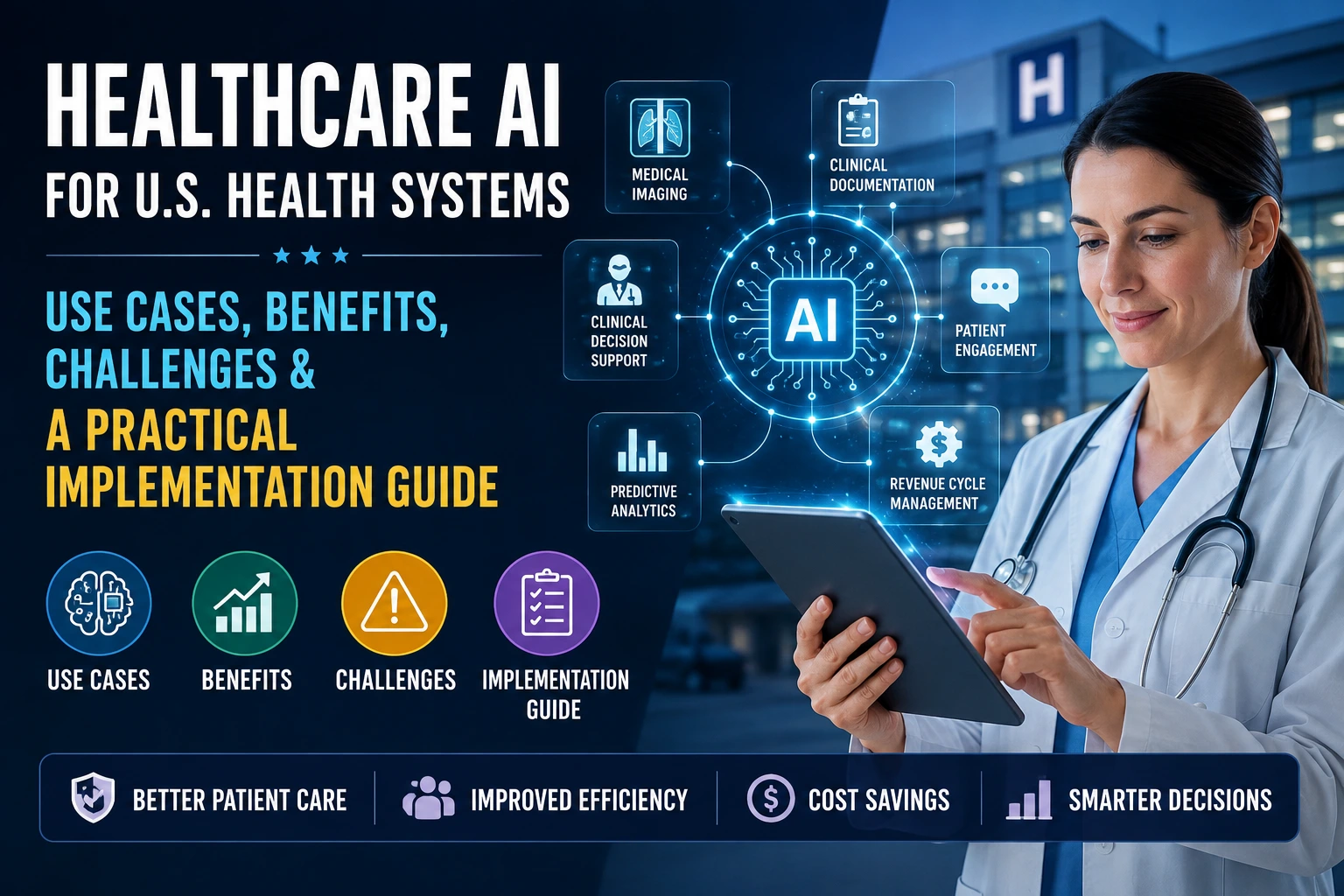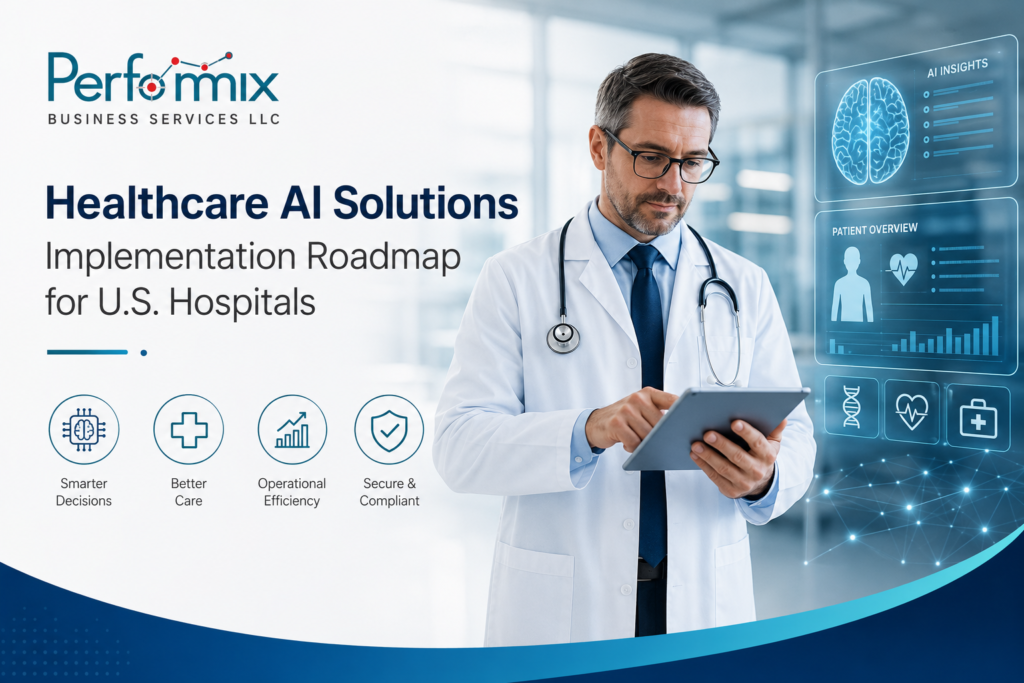
Artificial Intelligence (AI) is transforming healthcare across the United States. Hospitals are using AI to improve patient outcomes, automate administrative tasks, optimize clinical workflows, and reduce operational costs. From predictive analytics and medical imaging to intelligent scheduling and clinical documentation, AI is becoming an essential component of modern healthcare.
However, successful AI adoption requires more than purchasing software. Hospitals need a strategic implementation roadmap that aligns technology with clinical goals, regulatory compliance, and workforce readiness.
At Performix Business Services LLC, we help healthcare organizations implement secure, scalable AI solutions that integrate seamlessly with existing systems while delivering measurable business value.
Why U.S. Hospitals Are Investing in AI
Healthcare organizations face growing challenges, including physician shortages, increasing patient volumes, rising operational costs, and strict regulatory requirements. AI provides practical solutions by helping hospitals:
- Improve diagnostic accuracy
- Reduce physician burnout
- Automate repetitive administrative work
- Optimize patient scheduling
- Accelerate clinical documentation
- Improve revenue cycle management
- Predict patient risks earlier
- Enhance patient experiences
Hospitals implementing AI strategically often experience faster decision-making, better operational efficiency, and improved patient satisfaction.
What Are Healthcare AI Solutions?
Healthcare AI solutions use machine learning, natural language processing (NLP), computer vision, and predictive analytics to support clinical and operational processes.
Common healthcare AI applications include:
- Medical imaging analysis
- Clinical decision support
- Predictive patient risk scoring
- Automated medical coding
- Healthcare workflow automation
- AI-powered virtual assistants
- Patient scheduling optimization
- Electronic Health Record (EHR) intelligence
- Revenue cycle optimization
- Population health analytics
Step 1: Assess Organizational Readiness
Before implementing AI, hospitals should evaluate their organizational readiness.
Key questions include:
- What business problems should AI solve?
- Which departments will benefit most?
- Is executive leadership aligned?
- Are clinicians prepared for AI adoption?
- Is the IT infrastructure capable of supporting AI?
Organizations should establish clear objectives such as reducing emergency room wait times, improving radiology workflows, increasing scheduling efficiency, or lowering operational costs.
Build an AI Governance Team
Successful AI implementation requires collaboration between:
- Executive leadership
- Physicians
- Nurses
- IT teams
- Compliance officers
- Data analysts
- Cybersecurity specialists
A governance committee ensures AI projects remain aligned with organizational goals, patient safety, and regulatory requirements.
Step 2: Build an AI-Ready Data Foundation
AI is only as effective as the data it receives.
Hospitals should focus on:
- Cleaning duplicate patient records
- Standardizing clinical data
- Improving data quality
- Connecting legacy systems
- Implementing HL7 FHIR interoperability
- Securing patient information
- Creating centralized data repositories
Strong data governance ensures AI models deliver accurate, reliable, and compliant results.
Ensure HIPAA Compliance
Healthcare AI initiatives must protect sensitive patient information by implementing:
- Role-based access controls
- Data encryption
- Audit logging
- Secure cloud environments
- Continuous monitoring
Maintaining HIPAA compliance is critical for protecting patient privacy and reducing organizational risk.
Step 3: Identify High-Impact AI Use Cases
Hospitals should prioritize projects that deliver measurable business value.
Radiology AI assists radiologists by detecting abnormalities faster, prioritizing urgent scans, and reducing reporting time.
Clinical Documentation Generative AI automates physician note creation, reducing administrative workload and physician burnout.
Patient Scheduling AI improves appointment scheduling by predicting cancellations, optimizing provider availability, and reducing patient wait times.
Revenue Cycle Management Healthcare AI automates:
- Medical coding
- Claims validation
- Billing accuracy
- Payment forecasting
Predictive Analytics Machine learning identifies patients at higher risk for:
- Readmission
- Sepsis
- Chronic disease progression
- Emergency interventions
Step 4: Start with a Pilot Program
Rather than implementing AI across the organization immediately, hospitals should begin with a focused pilot project.
Ideal pilot departments include:
- Radiology
- Emergency Department
- Cardiology
- Revenue Cycle
- Patient Scheduling
During the pilot phase, organizations should monitor:
- Clinical accuracy
- Staff adoption
- Patient satisfaction
- Workflow improvements
- Cost reductions
Pilot programs minimize implementation risks while generating valuable insights for enterprise-wide deployment.
Step 5: Integrate AI into Clinical Workflows
AI adoption succeeds when clinicians can use new tools without disrupting existing workflows.
Hospitals should integrate AI directly into existing Electronic Health Record (EHR) systems rather than requiring clinicians to switch between multiple applications.
Integration areas include:
- Epic
- Oracle Health (formerly Cerner)
- Clinical dashboards
- Imaging platforms
- Patient portals
A seamless user experience significantly improves adoption rates.
Step 6: Train Healthcare Professionals
Technology alone does not ensure success.
Hospitals should provide structured training programs covering:
- AI fundamentals
- Clinical workflow integration
- Responsible AI usage
- Human oversight
- Data privacy
- Cybersecurity awareness
Healthcare professionals should understand that AI supports clinical decision-making rather than replacing medical expertise.
Step 7: Measure Performance and ROI
AI implementation should deliver measurable business outcomes.
Key performance indicators (KPIs) include:
| KPI | Example Outcome |
|---|---|
| Patient Wait Time | Reduced by 30% |
| Physician Documentation Time | Reduced by 50% |
| Claim Processing Speed | Improved by 40% |
| Readmission Rate | Lowered through predictive analytics |
| Operational Costs | Reduced through automation |
| Patient Satisfaction | Improved through faster service |
Regular performance reviews help organizations refine AI models and maximize long-term value.
Common Challenges in Healthcare AI Implementation
Healthcare organizations commonly encounter:
- Poor data quality
- Legacy technology systems
- Staff resistance
- Cybersecurity concerns
- Regulatory compliance requirements
- Integration complexity
- AI bias and transparency issues
Addressing these challenges early significantly increases implementation success.
The Performix Healthcare AI Adoption Framework™
At Performix Business Services LLC, we recommend a structured six-step framework for successful AI adoption:
- Assess — Evaluate business goals, workflows, and readiness.
- Prepare — Improve data quality, governance, and infrastructure.
- Integrate — Connect AI with existing healthcare systems.
- Pilot — Launch targeted AI projects in selected departments.
- Optimize — Measure performance, refine models, and improve adoption.
- Scale — Expand successful AI initiatives across the organization.
This framework helps hospitals reduce implementation risk while accelerating measurable business outcomes.
Why Choose Performix Business Services LLC?
Performix Business Services LLC provides enterprise AI consulting services tailored to healthcare organizations across the United States.
Our expertise includes:
- Healthcare AI consulting
- Data analytics
- Workflow automation
- Predictive analytics
- Cloud migration
- Enterprise application integration
- Custom AI development
- Digital transformation consulting
We help hospitals implement secure, scalable AI solutions that improve patient care while increasing operational efficiency.
FAQ
What are healthcare AI solutions? Healthcare AI solutions use artificial intelligence technologies such as machine learning, predictive analytics, and natural language processing to improve clinical care and hospital operations.
How long does AI implementation take? Depending on project complexity, pilot implementations typically require 3–6 months, while enterprise-wide deployments may take 12–24 months.
Is AI HIPAA compliant? AI systems can be HIPAA compliant when organizations implement appropriate security controls, encryption, access management, and governance policies.
Does AI replace doctors? No. AI assists healthcare professionals by automating repetitive tasks and providing decision support. Final clinical decisions remain with licensed medical professionals.
Which hospital departments benefit most from AI? Radiology, pathology, emergency medicine, revenue cycle management, patient scheduling, and clinical documentation often see the fastest return on investment.
Conclusion
Artificial intelligence is reshaping the future of healthcare. Hospitals that adopt AI strategically can improve patient outcomes, reduce operational costs, enhance clinician productivity, and build more resilient healthcare systems.
By following a structured implementation roadmap — assessing readiness, strengthening data foundations, selecting high-impact use cases, launching pilot projects, integrating AI into clinical workflows, and continuously measuring performance — healthcare organizations can achieve sustainable, measurable results.
Performix Business Services LLC partners with hospitals and healthcare organizations across the United States to deliver secure, scalable AI consulting and implementation services that drive digital transformation and long-term value.
Ready to accelerate your healthcare AI journey? Contact Performix Business Services LLC today to schedule a consultation and discover how our AI experts can help your hospital implement intelligent, compliant, and results-driven healthcare solutions.