Executive Summary
Organizations today generate and manage enormous volumes of internal knowledge — policies, manuals, contracts, SOPs, engineering standards, compliance documentation, HR procedures, and operational guidelines.
Yet accessing this information remains slow, fragmented, and inefficient.
Employees spend valuable time:
- Searching through PDFs
- Navigating outdated intranets
- Waiting for email responses
- Asking repetitive questions
- Struggling with inconsistent information
As organizations grow, knowledge becomes increasingly siloed across departments and systems.
Modern AI Assistants powered by Retrieval-Augmented Generation (RAG) are transforming how organizations access and use internal knowledge.
Instead of manually searching documents, employees can now ask questions conversationally and receive instant, context-aware answers sourced directly from approved organizational content.
This whitepaper explores:
- The challenges of traditional knowledge systems
- How RAG-powered AI Assistants work
- Real-world enterprise use cases
- Business impact and operational benefits
- Security and governance considerations
- The future of AI-powered workforce intelligence
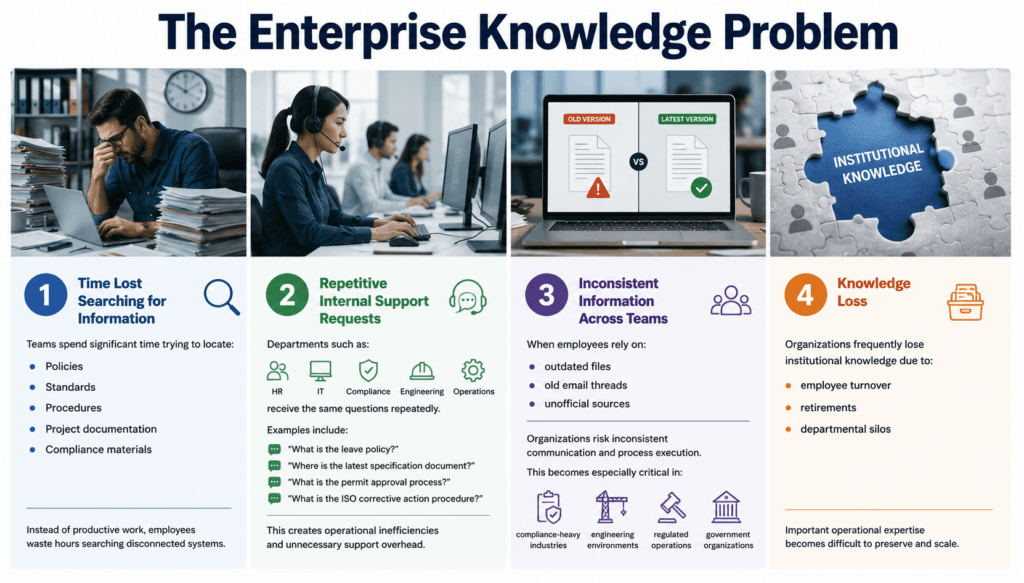
The Enterprise Knowledge Problem
Most organizations already possess the knowledge employees need.
The real problem is accessibility.
Critical information often exists across:
- PDFs
- Shared drives
- Internal portals
- Email chains
- Spreadsheets
- Legacy intranets
- Departmental repositories
Over time, employees face several challenges:
Why Traditional Knowledge Systems Fall Short
Most legacy systems were designed for document storage — not intelligent access.
Traditional systems require employees to:
- know where information exists
- understand complex folder structures
- search manually
- interpret technical documents independently
Even advanced intranets and search systems often struggle with:
- contextual understanding
- conversational interaction
- fragmented data structures
- document overload
The result:
Organizations store knowledge successfully — but fail to make it truly accessible.
The Rise of AI-Powered Knowledge Assistants
Recent advancements in Artificial Intelligence and Large Language Models (LLMs) have introduced a new approach to organizational knowledge access.
Using Retrieval-Augmented Generation (RAG), organizations can now create AI Assistants trained on their own internal documents and operational content.
These assistants allow users to interact with enterprise knowledge through natural conversation.
Instead of searching:
Employees simply ask.
What Is Retrieval-Augmented Generation (RAG)?
Retrieval-Augmented Generation (RAG) combines:
- enterprise document retrieval
- AI language understanding
- contextual response generation
into a unified intelligent assistant experience.
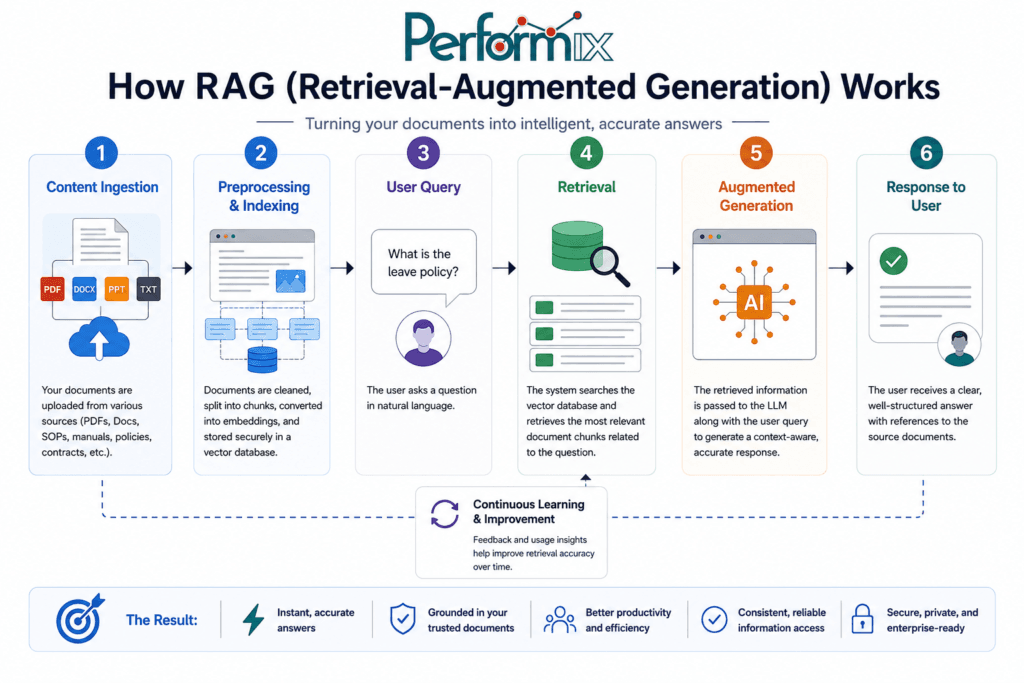
How It Works
Step 1 — Organizational Content Is Uploaded
The assistant is connected to:
- policies
- manuals
- SOPs
- engineering specifications
- contracts
- compliance documents
- operational guidelines
Step 2 — The AI Retrieves Relevant Information
When a user asks a question, the system searches approved internal knowledge sources to identify relevant information.
Step 3 — AI Generates a Contextual Response
The assistant delivers an accurate, conversational answer based on retrieved company-approved content.
This enables:
- faster access
- contextual understanding
- consistent communication
- scalable internal support
AI Assistants Built for Real Work
Unlike generic AI chatbots, enterprise AI Assistants are domain-specific and operationally focused.
These assistants are designed around real organizational workflows.
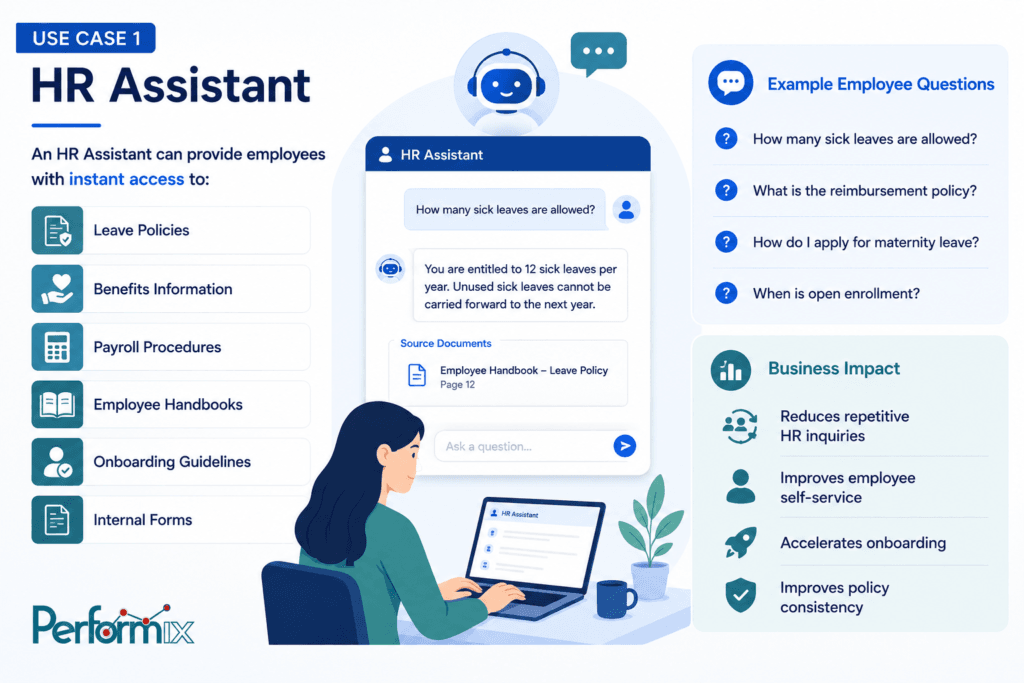
Use Case 1: AI HR Assistant
An AI HR Assistant helps employees instantly access HR policies, benefits, payroll procedures, onboarding guidelines, employee handbooks, and internal forms—reducing repetitive HR queries while improving self-service, onboarding efficiency, and policy consistency.
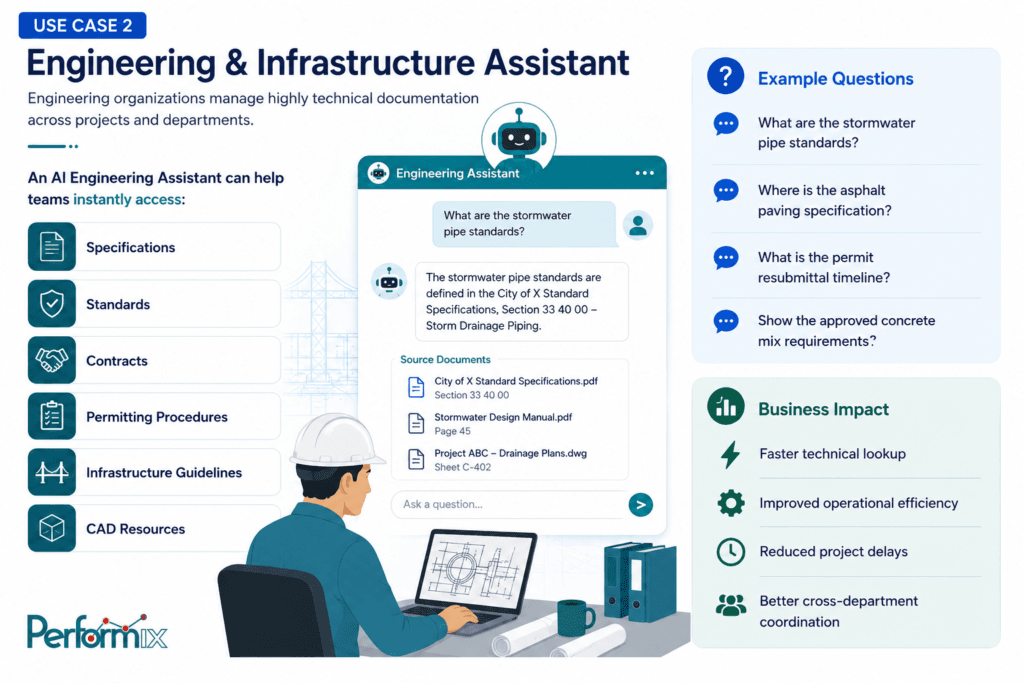
Use Case 2: Engineering & Infrastructure Assistant
An AI Engineering Assistant helps teams instantly access technical specifications, standards, contracts, permitting procedures, infrastructure guidelines, and CAD resources—enabling faster technical lookup, improved operational efficiency, reduced project delays, and better cross-department coordination
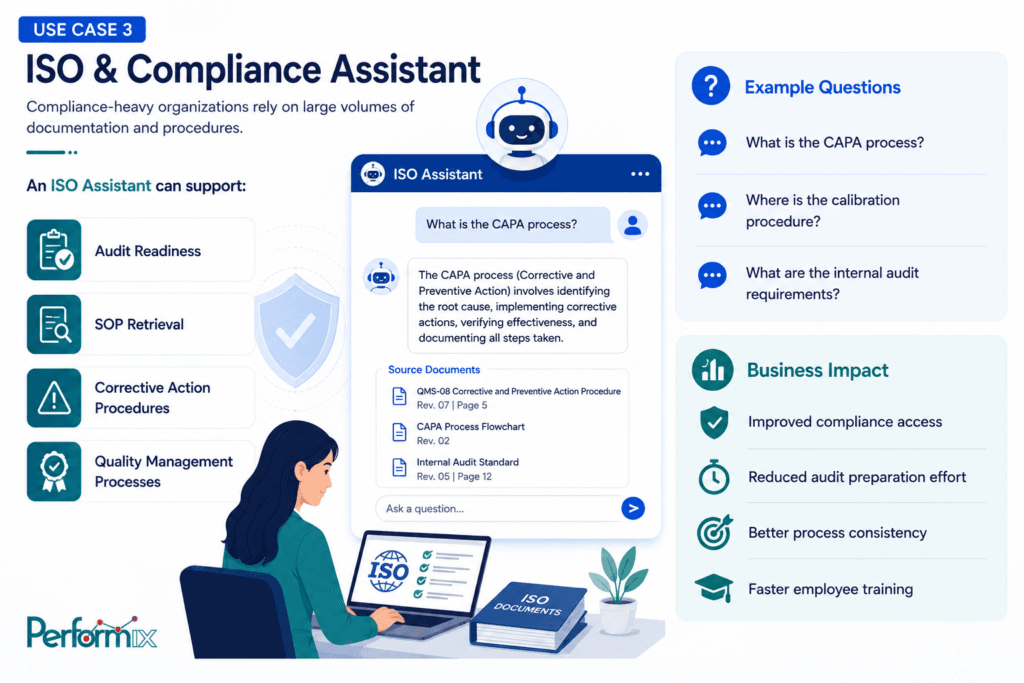
Use Case 3: ISO & Compliance Assistant
An AI ISO & Compliance Assistant helps organizations instantly access SOPs, corrective action procedures, audit documentation, and quality management processes—improving compliance accessibility, reducing audit preparation effort, ensuring process consistency, and accelerating employee training.
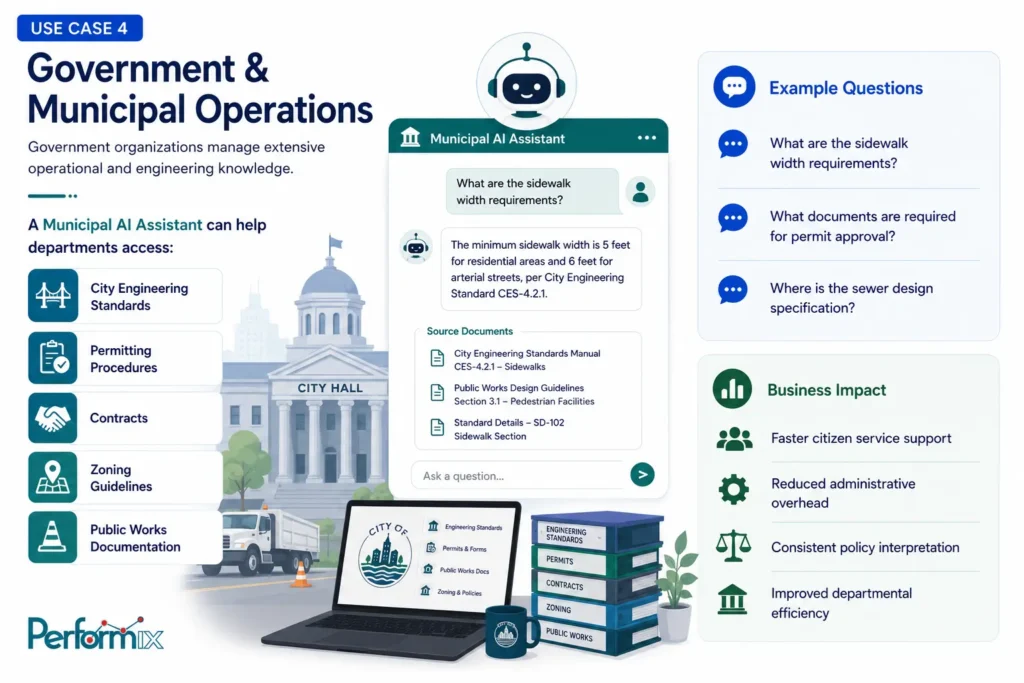
Use Case 4: Government & Municipal Operations
A Municipal AI Assistant helps government departments instantly access engineering standards, permitting procedures, contracts, zoning guidelines, and public works documentation—improving departmental efficiency, reducing administrative overhead, enabling faster citizen service support, and ensuring consistent policy interpretation.
Key Benefits of Enterprise AI Assistants
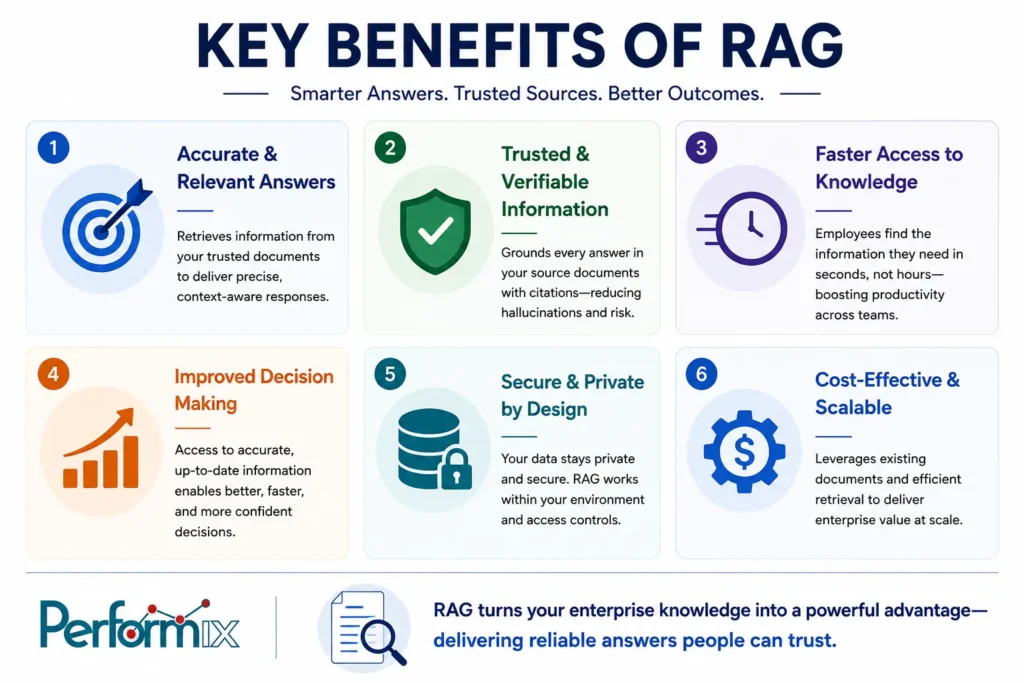
Instant Knowledge Access
Employees receive immediate answers without navigating complex document systems.
Reduced Operational Friction
AI Assistants eliminate repetitive internal support requests and reduce dependency on manual workflows.
Improved Productivity
Teams spend less time searching and more time executing meaningful work.
Better Knowledge Retention
Institutional expertise remains accessible even during organizational transitions.
Consistency Across Departments
Employees access standardized, organization-approved information.
Faster Employee Onboarding
New employees can learn procedures and policies more efficiently through conversational support.
Conclusion
Every organization already possesses valuable operational knowledge.
The challenge is no longer information creation — it is intelligent accessibility.
Retrieval-Augmented Generation (RAG) powered AI Assistants represent a major shift in how organizations interact with internal knowledge.
By transforming documents into conversational intelligence, organizations can:
- reduce operational friction
- improve employee productivity
- streamline support workflows
- preserve institutional expertise
- enable faster, smarter decision-making
AI Assistants are not simply another software tool.
They are becoming a foundational layer for modern enterprise operations.
About Performix Business Solutions
Performix Business Solutions develops AI-powered enterprise solutions designed to help organizations transform operational knowledge into intelligent, accessible systems.
From HR and compliance to engineering and municipal operations, Performix builds practical AI Assistants tailored for real-world business workflows.
Solutions Include
- Enterprise AI Assistants
- RAG-Powered Knowledge Platforms
- AI Workflow Automation
- Industry-Specific AI Solutions
- Internal Operations Intelligence