Top 10 AI Trends 2026 for Business Leaders
Artificial Intelligence is no longer a pilot—it’s a P&L lever. In July 2026, the U.S. enterprise signal sharpened: Gartner now projects that 40% of enterprise applications will embed task-specific AI agents by year-end, up from under 5% in 2025, while the U.S. Census Bureau shows enterprise AI adoption at 21.5% and on track to reach 24.3% within six months. At the same time, KPMG’s Q4 AI Pulse Survey finds cybersecurity as the single greatest barrier to AI strategy—80% of leaders cite it as their top concern—and 75% now prioritize security, compliance, and auditability as the most critical requirements for agent deployment. Meanwhile, Dun & Bradstreet’s Q3 2026 AI Momentum Survey reports that more than three-quarters of businesses are seeing measurable AI ROI, yet only 6% say their data is fully ready to support AI at scale.
For U.S. CEOs, founders, CIOs, and CTOs, the question has shifted from “Should we use AI?” to “How do we operationalize AI safely, securely, and profitably?” Companies are no longer impressed by demos. They want faster cycles, lower costs, defensible differentiation, and auditable outcomes.
As you plan for Q4, these are the 10 enterprise AI trends that will separate leaders from laggards in 2026—and the moves that turn AI from scattered experiments into a repeatable operating model.
1. AI Agents Are Replacing Simple Chatbots
The biggest AI trend of 2026 is the rise of AI Agents.
Traditional chatbots answered questions.
Today’s AI agents complete work.
Instead of simply responding to prompts, AI agents can independently perform multi-step business tasks such as:
- Resolving customer support tickets
- Comparing procurement vendors
- Screening job applicants
- Preparing sales proposals
- Reconciling finance invoices
The shift is significant.
2024–2025
AI answered questions.
2026
AI completes work.
Organizations are moving beyond conversational AI toward autonomous task execution integrated directly into enterprise workflows.
Question every business leader should ask:
Which workflows can AI complete without human intervention?
2. AI Is Moving from Pilot Projects to Enterprise Deployment
Throughout 2024 and 2025, organizations experimented with AI.
In 2026, experimentation is no longer enough.
Leadership teams expect measurable business value.
Instead of asking whether AI works, executives are asking:
- Where can AI reduce costs?
- How much faster can our teams work?
- Which use cases generate measurable ROI?
AI is moving out of innovation labs and into daily business operations.
Successful organizations are deploying AI across customer service, finance, HR, sales, and operations—not just testing isolated use cases.
3. Small AI Models Are Winning
Many organizations assumed that larger AI models automatically produced better results.
That assumption is changing.
Businesses increasingly prefer:
- Smaller domain-specific models
- Fine-tuned enterprise models
- Private AI deployments
These models offer several advantages:
- Lower infrastructure costs
- Faster response times
- Better security
- Easier deployment
- Greater control over business data
The question is no longer:
Which AI model is the biggest?
It’s:
Which AI model delivers the best business outcome?
4. AI Governance Has Become a Boardroom Priority
Every company wants AI.
No company wants:
- Customer data leaks
- Compliance failures
- Hallucinated decisions
- Security risks
As AI adoption accelerates, governance has become an executive responsibility.
Modern AI governance includes:
- Access permissions
- Audit trails
- Human approval workflows
- Model monitoring
- Security controls
- Risk management
Organizations that govern AI effectively will scale faster than those treating governance as an afterthought.
5. Enterprise Data Is More Valuable Than AI Models
Many executives spent the last two years comparing AI models.
Today, they recognize something more important.
Your competitive advantage isn’t GPT.
Your competitive advantage is your business knowledge.
That includes:
- Internal documentation
- Standard operating procedures
- CRM systems
- ERP platforms
- Customer history
- Institutional knowledge
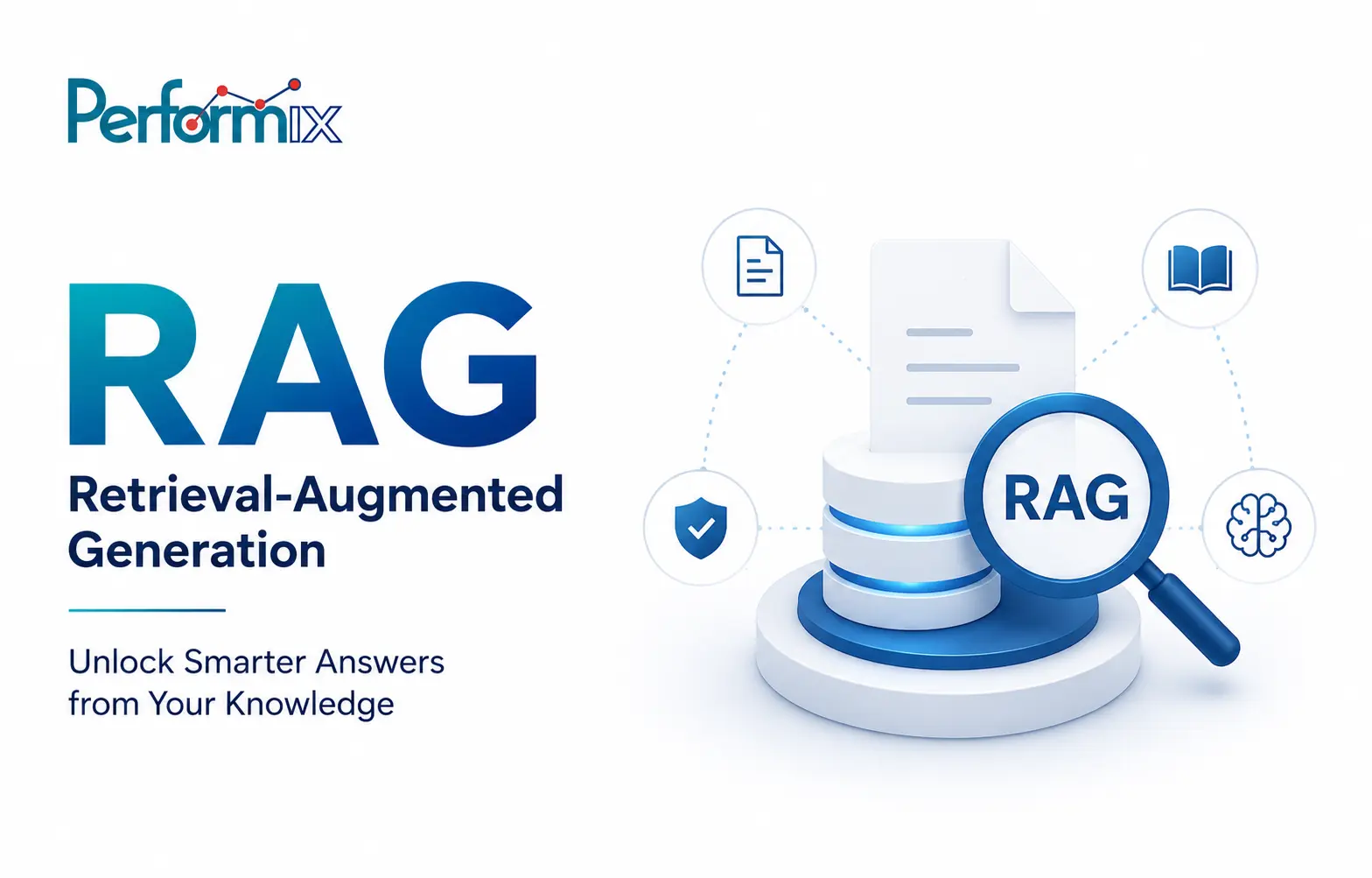
This explains why Retrieval-Augmented Generation (RAG) remains one of the highest-return AI architectures for enterprises.
Instead of relying solely on public model knowledge, organizations are grounding AI using trusted internal data.
6. AI Is Becoming Part of Every Business Application
Organizations no longer want dozens of disconnected AI tools.
Instead, they expect AI to be built into the software they already use.
Examples include:
- Microsoft 365
- Salesforce
- HubSpot
- SAP
- Oracle
- ServiceNow
AI is quietly becoming part of everyday business infrastructure.
Employees won’t need to “go use AI.”
AI will simply exist inside their daily workflows.
7. Multi-Agent Systems Are Redefining Enterprise Automation
One AI agent can improve productivity.
Multiple specialized AI agents can transform an organization.
Imagine a marketing campaign.
Research Agent
↓
SEO Agent
↓
Content Agent
↓
Design Agent
↓
Analytics Agent
Each agent performs one specialized function while collaborating with the others to complete complex workflows.
This modular approach improves:
- Accuracy
- Scalability
- Governance
- Operational efficiency
Multi-agent systems are quickly becoming one of the defining enterprise AI architectures.
8. AI Is Enhancing Human Work—Not Replacing It
The organizations seeing the strongest ROI are not replacing employees with AI.
They’re empowering employees through AI.
Professionals now use AI to:
- Draft reports
- Summarize meetings
- Analyze contracts
- Write software
- Build presentations
- Respond to customers
The greatest productivity gains come from embedding AI into existing workflows rather than replacing entire job roles.
The future belongs to organizations where humans and AI work together.
9. AI Infrastructure Matters More Than AI Models
Choosing the right AI model is only part of the equation.
Successful enterprise AI also depends on infrastructure.
Organizations are investing heavily in:
- Data pipelines
- APIs
- Enterprise integrations
- Governance platforms
- AI observability
- Security architecture
Without this foundation, AI remains another disconnected business tool.
10. AI Strategy Is Becoming the Ultimate Competitive Advantage
The organizations pulling ahead are asking better questions.
Not:
Which AI model should we use?
Instead:
- Which processes should AI automate?
- Which decisions should remain human-led?
- How do we measure AI ROI?
- How do we scale AI safely?
- How do we govern AI responsibly?
Enterprise AI is no longer simply an IT initiative.
It is becoming a core business strategy.
AI for Every Business
Questions Every CEO Should Ask Before Investing in AI
Instead of asking:
❌ “How can we use ChatGPT?”
Ask:
- Which business processes consume the most time?
- Which repetitive tasks can AI automate safely?
- Which decisions rely on internal business knowledge?
- Which customer interactions can AI manage effectively?
- What proprietary data gives our AI a competitive advantage?
- How will we govern AI as it scales across the organization?
These questions lead to long-term AI success rather than short-term experimentation.
The Bottom Line for Business Leaders
As we move into Q4 2026, the question is no longer whether AI belongs in your business—it’s whether your organization is ready to turn AI into measurable business outcomes.
The companies leading the market aren’t necessarily using the largest AI models or investing the most in technology. They’re focusing on three priorities that consistently drive successful AI adoption:
1. Start with High-Impact Use Cases
Don’t try to automate everything at once. Begin with business functions where AI can deliver immediate and measurable value—such as customer service, finance operations, IT support, sales enablement, or internal knowledge management. Early wins build momentum and create a foundation for broader AI adoption.
2. Build Governance from Day One
AI without governance creates risk. Establish clear ownership, access controls, human oversight, audit trails, and performance monitoring before scaling AI across the organization. Governance isn’t a compliance checkbox—it’s what separates successful enterprise AI programs from stalled pilot projects.
3. Invest in Scalable AI Infrastructure
Avoid disconnected AI tools that solve isolated problems. Build an AI ecosystem with secure data pipelines, enterprise integrations, APIs, and scalable infrastructure that can support future growth. The strongest AI strategies are built for long-term business transformation, not short-term experimentation.
How Performix Helps You Stay Ahead of the AI Curve
At Performix Business Services, we help organizations move beyond AI experimentation and build production-ready AI solutions that deliver measurable business value.
Our expertise includes:
- Production-Ready AI Agents – Design, develop, and deploy intelligent AI agents with governance, evaluation frameworks, and human-in-the-loop controls.
- Custom AI Solutions – Build industry-specific AI applications tailored to your workflows, business goals, and operational requirements.
- Enterprise AI Integration – Connect AI seamlessly with your existing applications, ERP, CRM, cloud platforms, IoT ecosystems, and enterprise data.
- Secure & Responsible AI – Implement confidential computing, AI governance, cybersecurity, and compliance frameworks to reduce operational risk.
- Scalable Digital Transformation – Combine AI, IoT, blockchain, and custom software development into a unified technology strategy that drives long-term growth.
Whether you’re exploring your first AI initiative or scaling AI across your enterprise, Performix provides the technical expertise and strategic guidance to help you deploy AI with confidence.
Ready to Build a Production-Ready AI Strategy?
Don't just research—execute.
Partner with Performix Business Services to transform today’s AI opportunities into tomorrow’s competitive advantage.

Frequently Asked Questions
AI governance ensures AI systems are secure, compliant, transparent, and aligned with business objectives. It includes access controls, audit trails, human oversight, model monitoring, and risk management. Strong governance helps organizations scale AI confidently while protecting sensitive business data and meeting regulatory requirements.
As AI adoption accelerates, concerns around governance, cybersecurity, compliance, and data privacy have become board-level priorities.
Organizations are asking:
- Is our enterprise data safe?
- Should we use private AI models?
- How do we prevent data leakage?
- What governance framework should we implement?
Recent industry developments have reinforced the need for stronger AI governance and security.
Perhaps the hottest executive question in mid-2026.
Leadership teams want answers such as:
- How much cost can AI reduce?
- How much productivity will improve?
- Will AI increase revenue?
- What KPIs should we track?
The conversation has shifted from technology adoption to business outcomes. PwC reports that only a minority of organizations have achieved both revenue growth and cost reduction from AI, making ROI a central concern.
Generative AI focuses on creating content such as text, images, code, or audio based on user prompts. Agentic AI goes a step further by making decisions, coordinating tasks, interacting with enterprise systems, and completing workflows autonomously. In simple terms, Generative AI creates content, while Agentic AI performs work.
Traditional chatbots answer questions, whereas AI agents can complete end-to-end business tasks. Organizations are adopting AI agents because they improve productivity, reduce manual effort, accelerate workflows, and integrate directly with enterprise applications such as CRM, ERP, and customer support platforms.